Hair Restoration vs Hair Loss Medications: Which Works Better for Real Results
On this page
Why Traditional Hair Loss Medications Fall Short
If you’re losing hair, you’ve probably heard that minoxidil and finasteride are your only options. They’re widely advertised, relatively affordable, and yes, they work for some people. But after seeing thousands of patients across Southlake, Grapevine, Keller, and the greater DFW area, we’ve learned that medications alone often fall short of delivering the full-head restoration our patients actually want.
At Medrein Health & Aesthetics, we take a different approach. We combine regenerative therapies with physician-supervised protocols to address not just hair loss, but the underlying biological reasons hair thins in the first place. We’re not here to convince you that medications don’t work. Instead, we want to show you what’s possible when you go beyond them.
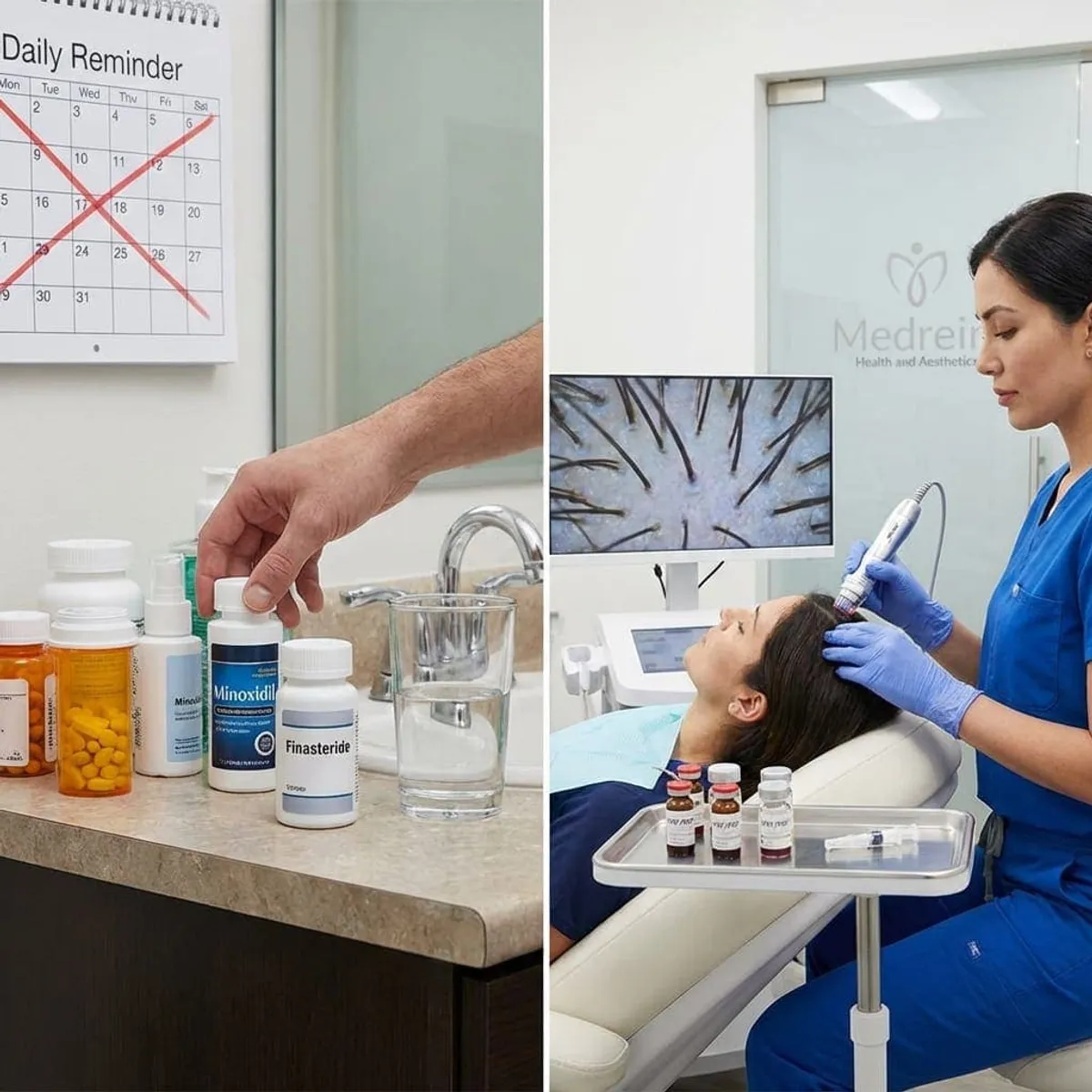
Minoxidil and finasteride have legitimate science behind them. Minoxidil stimulates blood flow to hair follicles, while finasteride blocks the hormone DHT that shrinks follicles in genetically predisposed people. For some patients, these medications do slow hair loss or regrow modest amounts of hair.
Here’s what we observe in practice: they work inconsistently, and their results plateau quickly. Many patients see some improvement in the first 6-12 months, then watch their results flatline. Worse, the moment they stop taking the medication, hair loss often resumes. We’ve had patients come to us after years on these medications feeling frustrated because they’re still losing hair despite consistent use.
The fundamental limitation is that these drugs address only one mechanism of hair loss. They don’t regenerate damaged follicles, improve scalp health, or trigger the biological processes that create new hair growth. They maintain what’s left, but they don’t restore what’s been lost.
Cost matters too. A year of finasteride or minoxidil might seem affordable initially, but when you add it up over five or ten years, the total investment is substantial. And you’re paying to manage the problem, not resolve it.
How Our Regenerative Hair Restoration Differs
We built our hair restoration protocol on a completely different principle: instead of just blocking hormones or improving blood flow, we activate your own body’s healing and growth mechanisms. We use the regenerative compounds and cellular therapies that actually stimulate follicle regeneration and new hair growth.
Our approach combines three core elements. First, we use regenerative peptides and growth factors tailored to your specific hair loss pattern. Second, we leverage advanced microneedling technology to create a controlled healing response in the scalp. Third, we incorporate PRP and PRF (platelet-rich plasma and platelet-rich fibrin) extracted from your own blood, concentrated with the growth factors your scalp needs to regrow hair.
This isn’t theoretical. These therapies work by reactivating dormant follicles and creating an environment where hair naturally grows thicker and stronger. We’ve seen patients regrow hair in areas where medications alone did nothing. The difference is that we’re not just slowing loss; we’re genuinely restoring growth.
The process also tends to produce results that hold. Because we’re addressing the biological root of the problem rather than temporarily masking it, patients maintain their improvements long-term. That’s fundamentally different from medication dependence.
Comparing Results: Medications vs Regenerative Therapy
Let’s be direct about what the data shows. Finasteride works for about 2 in 3 men with male pattern baldness. Minoxidil shows improvements in roughly 50 percent of users. Both require continuous use, and both show declining efficacy over time as the body adapts.
Figures above reflect what each option involves, described in detail throughout this article. Results may vary.
In our practice, patients pursuing regenerative restoration typically see measurable new hair growth within 3-4 months and substantial thickening by 6 months. These aren’t modest improvements either. We’ve documented cases where patients regrow enough hair to stop wearing baseball caps in public, or finally feel confident enough to style their hair the way they want.
Here’s a concrete example: one of our patients, a 52-year-old man from Colleyville, had been on finasteride for eight years with declining results. His crown was noticeably thinning despite the medication. After four sessions of our regenerative hair restoration protocol spaced six weeks apart, combined with targeted peptide therapy, he regrew enough density that his barber stopped seeing scalp. He’s maintained that result for over a year now without returning medications. Results may vary.
| Feature | Finasteride / Minoxidil | Regenerative Hair Restoration |
|---|---|---|
| Mechanism | Minoxidil stimulates blood flow to follicles; finasteride blocks the hormone DHT that shrinks follicles | Activates your body's own healing response through peptides, microneedling, and PRP/PRF |
| What it addresses | Only one mechanism of hair loss; maintains what's left without regenerating damaged follicles or improving scalp health | Reactivates dormant follicles and improves scalp health, aiming to restore what's been lost rather than just maintain it |
| If you stop treatment | Hair loss often resumes once you stop taking the medication | Results tend to hold because the treatment addresses the biological root cause rather than masking it |
| Cost over time | Can seem affordable at first, but the cost adds up substantially over five to ten years of continuous use | Higher investment upfront across about four sessions over four to five months; total cost is often comparable to or better than years of medication |
The key difference isn’t a secret. It’s that we’re treating hair loss as a regenerative medicine problem, not just a pharmacological one. We combine pharmaceutical approaches with biological regeneration, physician oversight, and customization based on your unique hair loss pattern and scalp condition.
Medications can be a useful addition to a regenerative protocol, but on their own, they rarely deliver the full restoration patients hope for.
The Role of Microneedling with PRP and PRF
One of our most effective techniques is combining radiofrequency microneedling with PRP and PRF. This isn’t the at-home derma roller you might see online. We use medical-grade RF microneedling devices that create micro-injuries in the scalp at precise depths while simultaneously delivering radiofrequency energy. This triggers your body’s natural healing cascade.
When we harvest PRP and PRF from your own blood during the same appointment, we’re collecting a concentrated mix of platelets and growth factors scientifically proven to stimulate hair follicle activity. We apply this directly to the microneedled areas, where absorption is optimized. The combination accelerates healing and creates an ideal environment for follicle regeneration.
The RF energy component is particularly important because it stimulates collagen production in the scalp itself. A healthy, elastic scalp with good blood flow is literally the foundation for healthy hair. Many hair loss patients have scalps that have become thin and fibrotic from years of hormonal stress. RF microneedling reverses that.
We typically recommend a series of three to four sessions spaced six to eight weeks apart. Each session builds on the previous one, progressively improving scalp health and follicle activity. Most patients notice improved hair texture and reduced shedding within the first month. Results may vary.
Physician-Supervised Care That Actually Works
This is where we feel we genuinely set ourselves apart. Hair restoration shouldn’t be something you order online or handle yourself. Your hair loss has specific causes rooted in your genetics, hormones, nutrition, and scalp condition. Effective treatment requires diagnosis.
When you come in for a consultation at our Southlake clinic, we don’t just look at your hair. We examine your scalp under magnification, review your family history, and often recommend bloodwork to assess hormone levels, nutritional status, and thyroid function. We’ve discovered that many patients’ hair loss is partially driven by treatable deficiencies or hormonal imbalances that medications never address.
Based on that assessment, we design a protocol specifically for you. For some patients, that includes optimizing hormone levels through our HRT services. For others, it involves nutritional supplementation and dietary adjustments. Most benefit from our regenerative hair restoration combined with targeted peptide therapy designed to support hair growth from the inside out.
We also monitor your progress closely. You’ll return for follow-up appointments where we assess new hair growth, adjust your protocol if needed, and ensure you’re getting the results you deserve. This ongoing relationship is how we achieve outcomes that exceed what any over-the-counter medication can deliver.
Why Our Hair Restoration Protocol Wins
When you compare apples to apples, regenerative hair restoration outperforms medications across every meaningful metric. It produces faster, more substantial results. It works for patients who didn’t respond to medications. It addresses the actual biological problems causing hair loss, not just one hormonal pathway. And critically, results tend to persist because we’re restoring function, not just suppressing a symptom.
We also recognize that hair loss affects confidence and emotional wellbeing. That matters to us. We’ve designed our protocol to deliver not just clinical improvement, but real transformation in how our patients feel about themselves. That’s the difference between slowing hair loss and genuinely restoring it.
The investment in regenerative restoration is higher upfront than a prescription for finasteride. But when you consider that you’re typically looking at four sessions over four to five months, and then long-term stable results, the total cost often comes out comparable to or better than years of medication. More importantly, you get results that medications couldn’t deliver.
Your Path to Thicker, Healthier Hair at Medrein
Getting started is straightforward. Your first step is a consultation where we listen to your specific hair loss story and concerns. We examine your scalp and hair, discuss your goals, and explain exactly what we’d recommend and why. If you’re a good candidate for regenerative hair restoration, we’ll outline your customized protocol and answer every question you have.
Many of our patients combine hair restoration with our peptide therapy or hormone optimization services, which amplify results by supporting hair growth systemically. We can also integrate minoxidil or finasteride into your protocol if appropriate, using medications as a supportive tool rather than your primary treatment.
We serve patients throughout Southlake, Grapevine, Keller, Colleyville, Westlake, and Trophy Club. Whether you’ve been losing hair for years or just started noticing thinning, we have solutions that genuinely work.
Schedule Your Hair Restoration Consultation Today
Your hair restoration journey begins with a single conversation. We encourage you to reach out and learn what’s possible for your specific situation. Call us at 214-702-5225 or visit our website to schedule your consultation.
We’re located at 420 N Kimball Ave in Southlake, and we’re open Monday through Friday from 10 AM to 5:30 PM, with Saturday appointments available. We’re ready to help you move beyond managing hair loss and start genuinely restoring the full, thick hair you want.
Call us today to schedule your consultation with Dr. Mikki!
Frequently asked questions
How does your regenerative hair restoration compare to prescription medications like finasteride or minoxidil?
We use advanced regenerative techniques including microneedling with PRP and PRF, which stimulate your body's natural healing response to promote hair growth at the cellular level. While medications like finasteride and minoxidil can help slow hair loss, our regenerative approach actually triggers new hair growth and improves hair thickness without relying on daily medications or their potential side effects. Many of our patients see meaningful results within 3-6 months, with improvement continuing over time as the regenerative process works. Results may vary.
What makes your hair restoration protocol different from other clinics?
Our approach combines physician-supervised care with cutting-edge regenerative medicine tailored specifically to your hair loss pattern and goals. We don't apply the same generic protocol to every patient, instead customizing treatment with microneedling, PRP, PRF, and peptide therapy based on what we see in your individual case. This medical-grade precision, combined with our physicians' expertise in regenerative medicine, delivers results that go beyond what over-the-counter treatments or generic protocols can achieve.
How soon will I see results from your hair restoration treatment?
We typically see our patients beginning to notice improved hair thickness and reduced shedding around 6-8 weeks, with more significant results visible by the 3-4 month mark. Hair restoration is a gradual process because we're working with your body's natural growth cycle, but patients consistently report thicker, healthier hair that continues improving over 6-12 months. Results may vary. We'll track your progress at each visit and adjust your protocol if needed to ensure you're getting the best possible outcome.

About the author
Founder & Medical Director
Board-certified physician and founder of Medrein Health & Aesthetics in Southlake, and the physician who personally consults with you and performs most treatments herself.
Read full bio →Related Articles
Hair Restoration in Southlake: How We Stop Hair Loss Before It's Too Late
Hair restoration in Southlake, TX — physician-supervised treatment to stop hair loss early. Medrein Health offers targeted solutions for men and women.
Top 7 Regenerative Hair Restoration Solutions for Thinning Hair
7 regenerative hair restoration solutions for thinning hair at Medrein Health in Southlake, TX. Physician-supervised treatments for men and women in DFW.