Hormone Replacement Therapy for Menopause: Cost & Safety

Medically reviewed by:

Founder & Medical Director
Wondering what HRT costs?
Dr. Mikki reviews your symptoms and labs, explains your delivery options, and gives you a cost estimate at consultation.
Book a Hormone Therapy ConsultationHormone replacement therapy (HRT) for menopause supplements the estrogen and progesterone your ovaries stop producing in adequate amounts during the menopausal transition. It is used to ease hot flashes, night sweats, disrupted sleep and the other symptoms that follow declining hormone levels, and to support long-term bone and heart health in women who start treatment close to menopause.
This guide covers how HRT works, the different ways it can be delivered, what drives the cost, and how safety is monitored over time, including the most recent FDA labeling update on hormone therapy.
What hormone replacement therapy treats
Hormone replacement therapy for menopause supplements the estrogen and progesterone that decline as the ovaries wind down. The goal is to stabilize hot flashes and night sweats while supporting bone density and long-term heart health, with the dose kept as low as the symptoms allow. Hormone Replacement Therapy at Medrein starts with bloodwork rather than a standard starting dose, and the plan is adjusted as your labs change. For perimenopause and menopause specifically, Women’s HRT covers estrogen, progesterone and, when labs support it, testosterone together.
Common symptoms HRT treats
Most patients come in because hot flashes and night sweats are disrupting daily life and sleep. Hormone replacement therapy for menopause also addresses genitourinary syndrome of menopause, which causes vaginal dryness and discomfort, along with the brain fog that many patients describe as trouble concentrating or finding words. Restoring hormonal balance is aimed at easing all three, and a consultation confirms which of them bloodwork can account for.
The biological role of estrogen and progesterone
Estrogen does more than support reproduction. It helps maintain bone density by slowing the natural breakdown of bone tissue, and it plays a role in regulating cholesterol. Progesterone protects the uterine lining from overgrowth in anyone taking estrogen who still has a uterus, and it can support sleep. FDA-approved options such as micronized progesterone (Prometrium) are one way this hormone is delivered. Replacing both hormones together is intended to mirror the balance the body held before menopause.
How hormone replacement therapy is delivered
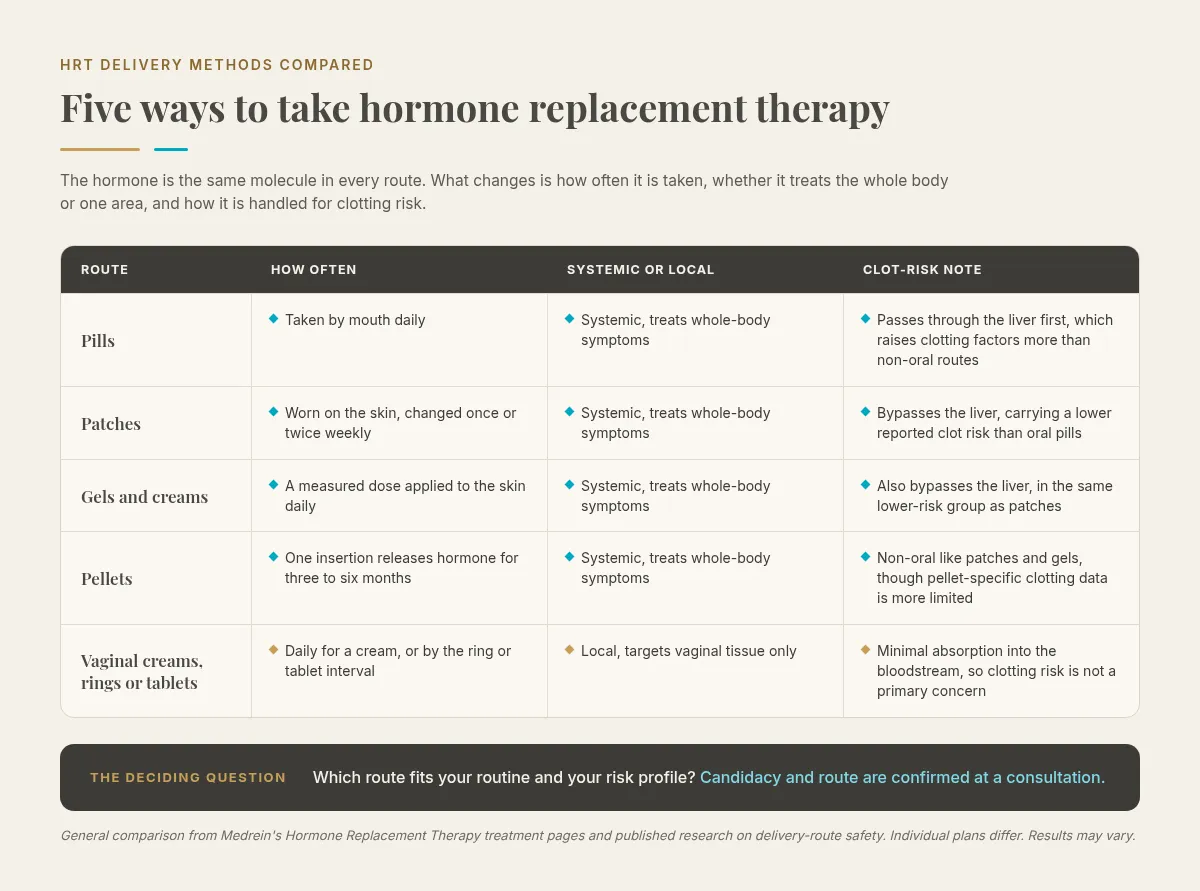
The delivery method is chosen based on medical history, symptoms and lifestyle. Systemic options send hormone into the bloodstream to treat whole-body symptoms such as night sweats, while local options treat vaginal tissue only, without raising hormone levels elsewhere in the body.
Systemic options: patches, gels and pellets
Transdermal patches adhere to the skin and release hormone steadily, applied once or twice a week depending on the product. Topical gels offer flexible, adjustable dosing for patients whose plan needs fine-tuning. Hormone Pellet Therapy places a compounded pellet about the size of a grain of rice under the skin during a short in-office visit, and it releases hormone gradually for three to six months before a repeat insertion is needed. Most patients return to normal activity the same day.
Oral vs non-oral administration
Oral tablets are a traditional route for FDA-approved hormone therapies, and they pass through the liver before reaching the bloodstream. That first pass through the liver increases clotting-factor production in some women. Non-oral methods such as patches and gels carry a lower clot risk than oral pills. Personal and family health history, including any history of gallbladder disease, helps determine which route is the safer starting point. Dr. Mikki reviews your baseline labs before recommending a delivery method, and that conversation happens at a consultation.
How much does HRT cost?
Hormone replacement therapy for menopause is priced individually, and Medrein does not publish a per-treatment price list. Three factors drive the total: the delivery method you choose, since pellets, patches, gels and pills carry different costs; the labs needed to set and monitor your starting dose; and how many follow-up visits your plan calls for as the dose is adjusted.
Our HRT cost guide walks through typical price ranges by delivery method and how insurance coverage factors in. At Medrein, you receive a specific quote at your consultation once Dr. Mikki has reviewed your symptoms and ordered the labs your plan is built on.
Bioidentical vs synthetic hormones: what you need to know
Bioidentical hormones are manufactured to match the molecular structure of the hormones your ovaries once produced, while synthetic hormones have a different chemical structure. The distinction matters because a molecule that matches the body’s own receptors fits more precisely, and some patients report fewer side effects on bioidentical formulations than on synthetic ones. Results vary by individual. Understanding the difference between a bioidentical hormone and a synthetic one is part of the conversation Dr. Mikki has with every patient before a prescription is written.
When a hormone fits its receptor closely, the body responds the way it is designed to. A synthetic hormone can be a less precise fit at the cellular level, which is one reason some patients report side effects such as mood changes, bloating or breast tenderness. Choosing a bioidentical hormone where appropriate is one way to work with the body’s existing pathways.
The case for bioidentical progesterone
Bioidentical progesterone is often described as having a calming effect, linked to how the molecule interacts with GABA receptors in the brain. It has not been shown to affect lipid profiles the way some synthetic progestins can. It is used both to protect the uterine lining and to support sleep quality, and some patients report that nighttime anxiety eases within the first few weeks of treatment. Results may vary. Dosing time of day is one detail Dr. Mikki adjusts to support sleep specifically.
Addressing the bioidentical hormone debate
Bioidentical does not mean unregulated or herbal. FDA-approved bioidentical hormones, such as micronized progesterone and estradiol patches or gels, go through the same testing for purity and consistency as any other prescription drug. Compounded bioidentical formulations, including hormone pellets, are prepared by a compounding pharmacy for one patient at a time and are not FDA-approved in the same way; Dr. Mikki explains that distinction before either option is chosen. The Menopause Society publishes patient guidance on hormone therapy that explains how regulated and compounded options differ. Knowing exactly what is being prescribed, and whether it is FDA-approved or compounded, is part of making an informed decision.
Evaluating the risks and safety of HRT
Research supports hormone replacement therapy as a reasonable option for most healthy women who start treatment within ten years of their final period or before age 60, a window in which the cardiovascular and bone benefits generally outweigh the risks for most candidates. Before any prescription, Dr. Mikki reviews personal and family history for estrogen-sensitive cancers, checks blood pressure, and weighs how those factors affect the choice of delivery method. Transdermal patches and gels carry a lower reported clot risk than oral tablets, and the lowest effective dose is the starting point for every plan.
A monitoring schedule for HRT
Safety monitoring follows a set schedule rather than a single visit. Baseline bloodwork is drawn before any prescription is written, to confirm hormone levels and rule out factors that would change the recommendation. An initial follow-up visit typically comes within the first two to three months, to check how your body is responding and adjust the dose if needed. During the first year, labs are usually repeated every three to six months, and once the dose is stable, testing often moves to an annual schedule. Routine preventive care, including an annual mammogram and a lipid panel, stays part of your care alongside hormone therapy, the same way it would without it.
The February 2026 FDA labeling update
As of February 2026, the FDA approved labeling changes to six menopausal hormone therapy products, removing cardiovascular disease, breast cancer and probable dementia risk statements from the boxed warning, the agency’s most prominent safety label. The change followed a review the FDA initiated in late 2025 and applies to each of the four categories of menopausal hormone therapy: combined estrogen and progestogen, estrogen alone, progestogen alone for women with a uterus who use estrogen, and topical vaginal estrogen. The FDA’s announcement notes that women who start hormone therapy within ten years of menopause, generally before age 60, showed a reduction in all-cause mortality and fractures in randomized studies. The agency still recommends reading the specific product labeling for full risk and benefit information, and Dr. Mikki reviews breast and cardiovascular health with mammograms and lab work regardless of what a label says.
Who should avoid hormone replacement therapy?
Some patients are not candidates for systemic hormone therapy. Any unexplained vaginal bleeding is investigated before treatment begins.
Who should avoid systemic HRT
Women with a history of stroke or deep vein thrombosis are not candidates for systemic hormone therapy.
When hormones are not the right fit, other options exist. Medical Weight Loss and Peptide Therapy support physical goals without changing hormone levels, and Dr. Mikki walks through those alternatives at a visit that reviews your full history and labs for patients who cannot take hormones.
Not sure which delivery method or dose is right for you?
Book a consultation and Dr. Mikki will review your labs, explain your options and build a monitoring schedule that fits your plan.
Starting hormone replacement therapy at Medrein
Starting hormone replacement therapy at Medrein begins with a full blood panel and a private consultation. Dr. Mikki reviews your hormone levels alongside thyroid function and vitamin levels, since energy and mood symptoms often have more than one cause. Hormone replacement therapy for menopause works best when labs, symptoms and history together guide the plan, and the dose is adjusted at follow-up as those change.
HRT can also be combined with other care. Medical Weight Loss is one example Dr. Mikki often coordinates alongside a hormone plan, since metabolism and hormone levels shift together through menopause. Most patients notice improvements in sleep and mood within a few weeks to a few months of starting treatment, and results vary by individual.
Dr. Mikki brings more than fifteen years of emergency medicine experience to every hormone consultation, a background that shapes how closely labs and symptoms are tracked over time. Bring any recent lab work or medical history to your first visit so the plan can be built around a complete picture from day one. Follow-up visits every three to six months during the first year keep the dose aligned with how your body responds.
If hot flashes, disrupted sleep or brain fog are affecting your daily life, book a consultation at Medrein’s Southlake clinic to start with a blood panel and a plan built around your own numbers.
Hormone Replacement Therapy for Menopause: Your Questions Answered
How long does it take for HRT to start working for hot flashes?
Most patients notice fewer hot flashes within one to two weeks of starting treatment, with fuller relief by around the three-month mark. Results may vary. Dr. Mikki monitors your response during this period and adjusts the dose if needed, aiming for the lowest amount that keeps symptoms comfortable. Consistent use is necessary to maintain the improvement.
Will hormone replacement therapy cause weight gain?
HRT for menopause symptoms is more often associated with weight stability than weight gain, since it can improve metabolic efficiency as estrogen is restored. Menopause itself tends to drive abdominal weight gain as estrogen declines, so replacing it is one part of addressing that shift. Dr. Mikki sometimes combines HRT with a Medical Weight Loss plan for patients who need additional metabolic support.
How much does hormone replacement therapy cost?
Cost depends on the delivery method, the labs needed to set your dose, and how many follow-up visits your plan requires. Medrein does not publish a per-treatment price list, so you receive a specific quote at your consultation once Dr. Mikki has reviewed your symptoms and ordered the right labs.
Can I take HRT if I have a family history of breast cancer?
A family history of breast cancer does not automatically rule out hormone therapy. Dr. Mikki performs a detailed risk assessment and reviews your recent mammograms before any prescription, and a transdermal delivery method is often prioritized when a family history raises specific concerns. These factors are discussed in full during a private consultation.
Is it ever too late to start hormone replacement therapy?
No, it's not strictly too late, though the window matters: the greatest cardiovascular and bone benefits come from starting within ten years of your final period, generally before age 60. Starting later calls for a more cautious evaluation of your baseline vascular health to weigh benefits against risks. Local treatment for symptoms such as vaginal dryness remains an option at any age.
Are bioidentical hormones safer than traditional HRT?
There is no clear evidence that bioidentical hormones are categorically safer than traditional HRT, though some patients report fewer side effects. They are manufactured to match the molecular structure of the hormones your body makes, which allows a closer receptor fit, and results vary by individual. FDA-approved bioidentical options, such as micronized progesterone (Prometrium) and estradiol patches or gels, go through the same testing as any other prescription drug, which differs from a compounded formulation made by a compounding pharmacy.
How often will my hormone levels be checked?
Hormone levels are typically checked every three to six months during the first year of treatment. Once a stable, effective dose is reached, testing often moves to an annual schedule. Dr. Mikki reviews these labs directly to confirm the plan is still safe and effective as your body changes.
Ready to talk about hormone replacement therapy?
Book a consultation and Dr. Mikki will review your symptoms, order the right labs, and build a plan with a clear monitoring schedule and cost estimate.
Related Articles

5 Best HRT Options in Southlake: Why Medrein Stands Apart
The 5 best HRT options in Southlake, TX, and why physician oversight matters. Medrein offers personalized hormone therapy for men and women in DFW.

Bioidentical vs Synthetic HRT: Which Improves Mood and Energy for Perimenopausal Women
Bioidentical vs synthetic HRT for mood and energy in perimenopause. Dr. Mikki at Medrein in Southlake compares both options for perimenopausal women.

Bioidentical HRT vs Synthetic: How We Optimize Mood and Cognition in Perimenopause
Bioidentical vs synthetic HRT for mood and cognition in perimenopause. Medrein in Southlake personalizes hormone therapy to support mental clarity.