Cheek Filler: How Long It Lasts, Cost & Sculptra vs HA
Medically reviewed by:

Founder & Medical Director
Is cheek filler right for you?
Dr. Mikki examines your midface and explains whether hyaluronic acid filler or a biostimulator fits your goals.
Book an Injectables ConsultationCheek filler is an injectable gel placed over the cheekbones and midface to replace volume that thins with age or weight change. As that volume drops, the face can look tired or flatter, and the lines around the nose and mouth can deepen.
Before booking, most people want to know which product suits their face and how long it will hold. This guide answers both, then covers cost, recovery and the risks you should know about first.
What cheek filler is and what it can do
Most cheek filler is hyaluronic acid (HA), a sugar your skin already makes. Injected along the cheekbone and midface, the gel holds water and restores the support that has thinned there. The result can soften a hollow look and ease some of the shadowing around the nose and mouth.
All of the Dermal Fillers Medrein uses are FDA-approved hyaluronic acid gels from four families: Juvéderm, Restylane, RHA and Revanesse Versa. Each family includes gels of different thickness, from thin gels for fine lip lines to firmer gels for cheek and jaw support. Dr. Mikki selects the specific product for each area at your consultation.
Cheek volume also affects the area just below it. When the midface deflates, the lower eyelid can look more hollow. Some patients need support in the cheek only, and others also benefit from under-eye filler, which is planned as a separate area.
What cheek filler cannot do
Filler replaces lost volume and has no tightening effect on loose skin. Dr. Mikki corrects this misunderstanding often at consultation. Adding more cheek filler to try to lift sagging skin tends to make the face look bulky. When laxity is the main concern, treatments that build collagen and firm the skin, such as RF Microneedling, are the more accurate tool.
Which fillers are FDA-approved for the cheeks
The FDA approves each dermal filler for specific areas of the face. The agency’s page on dermal filler safety lists cheek augmentation among the approved uses in adults over 21 and advises patients to read the labeling for the specific product they receive.
Among the gels Medrein carries, three are FDA-approved for cheek augmentation:
- Juvéderm Voluma XC is approved for deep injection to correct age-related volume deficit in the midface. Its FDA approval record sets out the indication.
- Restylane Lyft is approved for cheek augmentation and age-related midface contour deficiencies, as well as for folds and the backs of the hands.
- Restylane Contour is approved for cheek augmentation and midface contour deficiencies, and more recently for temple hollowing.
Other gels in the same families carry approvals for folds, wrinkles or lips. Dr. Mikki chooses the product for your cheek at the consultation, based on your anatomy and the result you want.
Hyaluronic acid filler vs Sculptra and Radiesse for cheeks
Hyaluronic acid is one way to restore cheek volume. Another is a collagen stimulator, known as a biostimulator, which prompts your own skin to lay down new collagen over the following weeks. Medrein’s Biostimulators service includes Radiesse and Sculptra, both used across the cheeks and midface, along with Bellafill.
The two groups differ most in how quickly the volume shows and whether the result can be reversed.
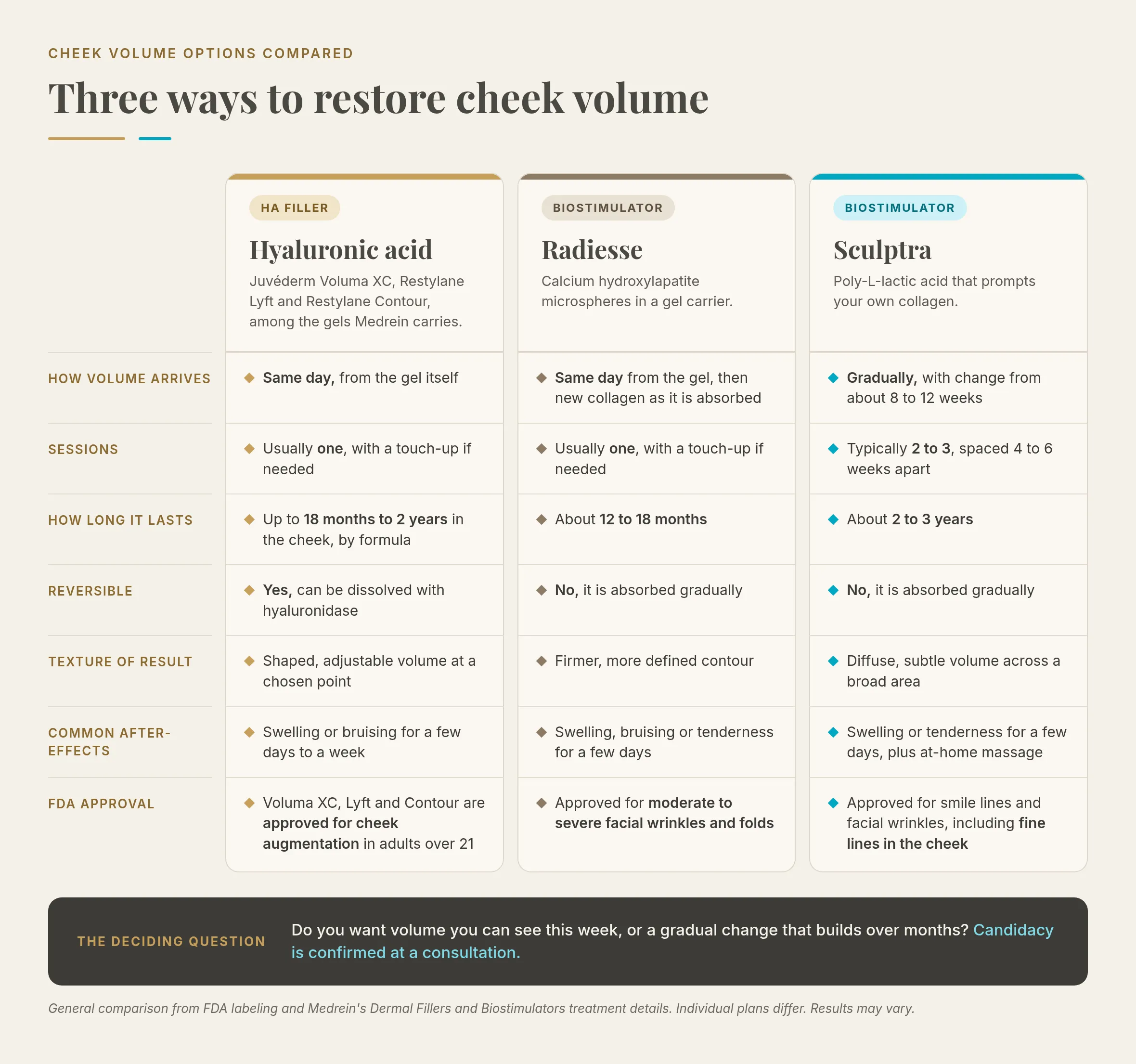
Hyaluronic acid filler suits a patient who wants a visible change the same week and likes knowing it can be adjusted. Radiesse is firmer and gives definition on the day, then builds collagen as its gel carrier is absorbed. Sculptra suits broad, gradual volume loss across the cheeks and temples. It usually takes two to three sessions spaced four to six weeks apart, and our Sculptra timeline walks through how that change builds.
The FDA has approved Radiesse for moderate to severe facial wrinkles and folds. Sculptra is approved for smile lines and other facial wrinkles, and in 2023 its approval was extended to fine lines and wrinkles in the cheek region, as the American Board of Cosmetic Surgery reported. Neither can be dissolved, so the decision to use one carries further than a hyaluronic acid treatment does.
How long does cheek filler last?
Longevity depends on the product, the area and how quickly your body breaks the material down. Deeper, firmer gels in the cheek tend to last longer than softer gels in areas that move a lot, such as the lips.
- Juvéderm Voluma XC typically holds one to two years.
- Restylane Lyft and Restylane Contour can last up to 18 months in the cheeks.
- RHA gels last up to 18 months.
- Radiesse lasts about 12 to 18 months.
- Sculptra results last about two to three years.
Hyaluronic acid fades gradually, so the face softens back toward its starting point over time. A touch-up can be planned as the result fades. Metabolism, exercise habits and sun exposure all play a part, which is why Dr. Mikki gives you a realistic range for your own face. Results may vary.
How many syringes do cheeks need?
There is no standard number. The amount depends on how much volume has been lost, the size of your face and bone structure, and whether one area or several is being treated. A patient in her thirties who wants subtle definition needs far less than a patient with significant midface deflation after weight loss.
Dr. Mikki prefers to place conservatively and assess the balance of the whole face. She will tell you plainly if your cheeks are already proportionate and do not need filler. The syringe count for your face is set at the consultation.
How much does cheek filler cost?
Filler is usually priced by the syringe, and the price differs between products. The total therefore depends on the product Dr. Mikki recommends and how many syringes your plan needs. Medrein does not publish a per-treatment price list, and you receive a quote at your consultation before anything is injected.
Patients who come in regularly can lower the cost through a membership. The Beauty Club and Glow Club both include $50 off fillers, and the Laser Club includes 10% off fillers. Dr. Mikki confirms which tier fits your plan before you join.
What happens at a cheek filler appointment
The first step is a consultation. Dr. Mikki examines your skin and facial proportions, asks about your medical history and medications, and explains what filler can and cannot do for the concern you came in with. Expect two appointments to finalize a plan.
On treatment day, the area is cleansed and a numbing cream is applied. Several of the cheek gels also contain lidocaine, so the area keeps numbing as the filler goes in. Dr. Mikki places the gel into the chosen points, then gently massages the area so it sits evenly under the skin. The injection itself takes around 30 minutes, and an appointment runs anywhere from 15 minutes to an hour, depending on how many areas are treated.
Most patients go back to normal activities the same day. For the first six hours, avoid touching the treated area. For the first 24 hours, stay away from intense heat and direct sun, and skip strenuous exercise and alcohol. Our aftercare guide covers the first 72 hours in more detail.
Cheek filler before and after
With hyaluronic acid filler, you see volume as soon as the gel is placed. Mild swelling in the first few days can make the cheeks look fuller than the final result. Once swelling and any bruising settle, usually within a few days to a week, the true shape shows. Radiesse follows a similar pattern on the day and then firms gradually as new collagen forms. Sculptra shows little at first and builds from about 8 to 12 weeks.
Photos from real patients are the best way to judge what a natural result looks like. Our patient gallery includes dermal filler results from the Juvéderm, Restylane and Revanesse families. Every face starts from a different point, so another patient’s result is only a rough guide to your own. Results may vary.
Does cheek filler make you look older or younger?
Placed in proportion, cheek filler can restore the midface support that thins with age, and the aim is a more rested look. The aged or overdone look people worry about usually comes from too much product or filler placed where the real issue is loose skin. An overfilled cheek can look heavy and flatten the natural curve of the face.
Dr. Mikki plans for balance with the rest of your face. She has declined to add filler when a patient asked for more than their face needed, because the goal is a result you still recognize as yourself.
Cheek filler side effects and risks
The most common side effects are temporary and appear at the injection sites. They include swelling, bruising, redness, tenderness and small bumps, and most settle within a few days to a week. Lumps or unevenness can form and can be corrected. Infection is rare.
The most serious risk is filler entering a blood vessel by accident. The FDA describes this as uncommon, but it can block blood flow and lead to tissue damage, vision problems or stroke. It is treated as an emergency. Hyaluronic acid can be dissolved with hyaluronidase, which is one reason it is the mainstay for facial work. Radiesse and Sculptra cannot be dissolved in the same way.
Choosing an injector who knows facial anatomy in detail lowers these risks. The American Society for Dermatologic Surgery publishes a patient overview of dermal fillers and how to choose a qualified injector. Seek care straight away if you notice unusual pain, skin that turns white or dusky, or any change in vision. Our guide to warning signs lists what to watch for after any injectable.
Who should wait or skip cheek filler
Good candidates are in good general health and over 21, with cheeks or a midface that have genuinely lost volume. Filler is postponed or avoided if any of these apply:
- You are pregnant or breastfeeding.
- An active skin condition sits in the area, such as acne, rosacea or psoriasis.
- You have a known allergy to hyaluronic acid, lidocaine or streptococcal proteins.
- You have a bleeding or clotting disorder or take a blood thinner.
- You have a history of hypertrophic or keloid scarring.
- You are within four weeks of a laser treatment, a Chemical Peel or dermabrasion.
Dr. Mikki confirms candidacy at the consultation after going through your history and medications.
Juvéderm Voluma XC, Restylane Lyft and Restylane Contour are FDA-approved for cheek augmentation in adults over 21. Whether cheek filler or a biostimulator suits you is decided at a consultation, after an exam of your whole face. Results may vary.
Getting started with cheek filler at Medrein
Cheek filler works best as a measured restoration of volume that has thinned. It tends to suit patients who want to look rested and prefer to make changes gradually. Choosing between hyaluronic acid filler and a biostimulator comes down to your anatomy and how soon you want to see a change.
If your cheeks have started to look flatter or more tired and you want to know what would help, book a consultation at our Southlake clinic. Dr. Mikki will examine your face and walk you through your options before anything is booked.
Cheek Filler FAQs
Is cheek filler reversible?
Hyaluronic acid cheek filler is. An enzyme called hyaluronidase breaks the gel down, so a result that needs softening can be adjusted. Radiesse and Sculptra cannot be dissolved, and the body absorbs them gradually, which is why Dr. Mikki explains that difference before you choose.
Does cheek filler hurt?
Most patients describe pressure and brief stinging. A numbing cream goes on first, and many of the cheek gels contain lidocaine, which numbs the area as the filler is placed. Tenderness can last a few days afterward.
How soon before an event should I get cheek filler?
Plan for at least two weeks. Swelling and any bruising usually settle within a few days to a week, and the final shape reads once they do. Sculptra is a poor fit for a near deadline, because its change builds from about 8 to 12 weeks. Results may vary.
Can cheek filler lift sagging skin?
No, filler replaces lost volume but has no tightening effect on lax skin. Adding more cheek filler to chase a lift tends to make the face look heavy. When laxity is the main concern, Dr. Mikki will talk through collagen-building and energy-based treatments instead.
How much does cheek filler cost at Medrein?
Cost depends on the product and how many syringes your plan needs. Medrein does not publish per-treatment prices, so you receive a quote at your consultation before anything is injected. Beauty Club and Glow Club members receive $50 off fillers.
Who should not get cheek filler?
Filler is postponed during pregnancy or breastfeeding and when an active skin condition or infection sits in the area. It is also avoided with a known allergy to hyaluronic acid or lidocaine, a bleeding disorder, or a history of keloid scarring. Dr. Mikki goes through your medical history and medications at the consultation.
Wondering what your cheeks actually need?
Book a consultation and Dr. Mikki will assess your facial proportions, explain your options and give you a quote before anything is injected.
Related Articles
Under Eye Filler: Candidacy Chart, Recovery and Side Effects
Under eye filler by a Southlake MD: a chart of which under-eye concerns filler suits, FDA-approved options, side effects and recovery. Book a consultation.

Physician's Guide to Facial Biostimulator Injections
A physician explains facial biostimulator injections: how Sculptra and Radiesse trigger your own collagen production for natural, longer-lasting results.

7 Best Pre-Injection Habits to Maximize Your Botox and Filler Results
7 pre-injection habits to prepare for Botox and filler treatments in Southlake, from Dr. Mikki: medications to pause, timing windows, and lifestyle tips.