Under Eye Filler: Candidacy Chart, Recovery and Side Effects
Medically reviewed by:

Founder & Medical Director
Is under eye filler right for you?
Dr. Mikki examines what is causing the shadow under your eyes before recommending Filler or another option.
Book an Injectables ConsultationUnder eye filler is an injection of hyaluronic acid gel into the tear trough, the groove that runs from the inner corner of the eye toward the cheek. When that area loses volume, it casts a shadow that can make you look tired even after a full night of sleep. A small amount of gel placed under the hollow can soften that shadow.
Under-eye darkness has several causes, and filler helps only one of them. Knowing which cause you have is the first step in judging whether the treatment is worth it for you.
What under eye filler is and how it works
The treatment uses the same hyaluronic acid gels as other Dermal Fillers, chosen in softer formulas suited to thin skin. Hyaluronic acid is a sugar molecule your skin already makes, and it holds water. Once placed in the tear trough, the gel adds volume directly and levels the step between the lower eyelid and the cheek.
The gel is placed deep, close to the bone or beneath the muscle that circles the eye. Deep placement helps the result look smooth and lowers the chance of the gel showing through the skin. Over months, the body breaks the gel down gradually, so the result is temporary and can be adjusted.
FDA-approved fillers for under-eye hollows
Two hyaluronic acid fillers have an FDA approval that specifically covers the under-eye area. The FDA approved Restylane Eyelight in 2023 to improve the appearance of sunken or hollow areas under the eyes in adults 21 and older. Juvéderm Volbella XC, first approved for the lips, gained an approval for under-eye hollows in adults over 21 in 2021. Both contain lidocaine to reduce discomfort during injection.
Medrein carries the Restylane and Juvéderm families, and Restylane Eyelight is one of the Restylane formulas on hand. Other hyaluronic acid fillers are sometimes placed under the eyes by experienced injectors, which is off-label use of an approved product. Dr. Mikki explains which product she recommends for your anatomy and why.
Are under eye fillers a good idea for you?
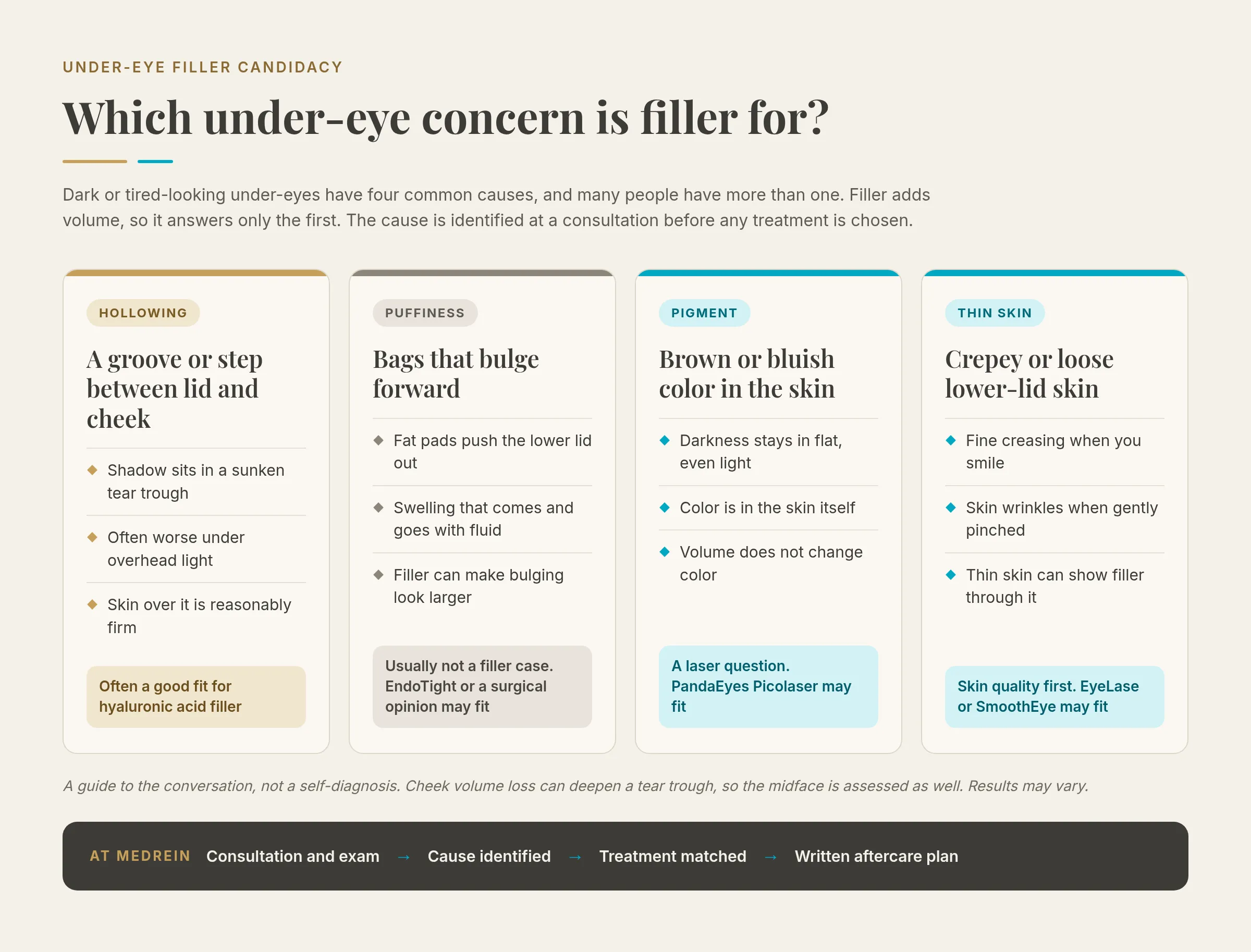
Filler is a good idea when the main problem under the eyes is volume loss. It is often a poor idea when the darkness comes from puffiness, pigment or thin, crepey skin, because adding gel does not fix those causes and can make some of them look worse. Many people have two or more causes at once, which is why the examination matters more than the product.
Hollowing in the tear trough
A true hollow looks like a groove or step where the lower lid meets the cheek, and it often looks deeper under overhead light. This is the pattern the FDA-approved products were studied for. People with naturally deep-set eyes and those who have lost facial fat with age or weight change often fall into this group.
Puffiness and fat pads
Bags that bulge forward come from fat pads pushing the lower lid out, from fluid, or from both. Filler placed next to a bulge can make the whole area look fuller. When loose skin over a small fat pad is the problem, a laser fiber treatment called EndoTight can reduce the pad and tighten the skin above it. Larger bags may call for a surgical opinion, and Dr. Mikki will tell you when that is the better route.
Pigment and thin skin
Brown or bluish color that stays visible in flat, even light usually sits in the skin itself, and volume does not change color. For pigment, our dark circle treatment uses a Picolaser designed for delicate skin around the eyes. When the lower-lid skin is crepey and creases easily, laser tightening with EyeLase and SmoothEye works on skin quality first, and thin skin is also more likely to show filler through it.
The cheek connection
A tear trough often looks deeper because the cheek below it has lost volume and support. In that case, restoring the midface first may soften the under-eye hollow with less product near the eye. Our guide to cheek filler explains how that support works.
Who is not a good candidate for under eye filler?
Some health conditions and situations make Filler a poor choice, or a choice to postpone. These are the most common reasons Dr. Mikki advises against it:
- Pregnancy or breastfeeding.
- An active skin condition near the eyes, such as acne, rosacea, eczema or an infection.
- A known allergy to hyaluronic acid, lidocaine or the bacterial proteins some fillers are made from, or a history of severe allergic reactions.
- A bleeding or clotting disorder, a blood thinner, or a connective tissue disorder such as lupus.
- A history of hypertrophic scarring or keloids.
- Laser treatment, IPL, a Chemical Peel or dermabrasion within the past four weeks.
- Large, bulging bags or heavy lower-lid swelling that comes and goes.
The FDA-approved under-eye products are indicated for adults 21 and older. If you are unsure whether something in your history matters, bring it to the consultation, and it will be discussed before any product is chosen.
What happens during a tear trough filler appointment
Treatment starts with a consultation. Dr. Mikki examines your under-eyes and cheeks and goes through your medical history. She then explains what Filler can and cannot change for you. If you decide to go ahead, the area is cleansed and a numbing cream is applied.
Dr. Mikki places the gel in small amounts, and the area may be gently massaged so the gel sits evenly. An appointment runs from about fifteen minutes to an hour, depending on how many areas are treated. Many patients see a softer hollow before they leave, with swelling that settles over the following days.
What to expect before and after under eye filler
Under-eye skin is thin, so bruising and swelling are more noticeable here than in many other areas. Most people return to normal activities straight away. The first few days follow a fairly predictable pattern:
- First 24 hours: mild swelling, tenderness and pinpoint bruises at the injection sites. Avoid touching the area for at least six hours.
- First few days: swelling and any bruising are most visible, and a bruise can shift from purple to yellow as it fades.
- Within one to two weeks: swelling settles and the final shape becomes clear.
For the first day, skip strenuous exercise, alcohol, intense heat and direct sun, and leave other cosmetic treatments for two weeks. Our tips on minimizing bruising cover ice, head elevation and the supplements to pause.
How long does under eye filler last?
In the clinical studies behind the FDA approvals, results for both Restylane Eyelight and Juvéderm Volbella XC lasted up to about 12 months, and some patients needed a second session to reach the best outcome. Metabolism, the product used and how much volume was lost all affect how long it lasts.
A top-up is planned for when the hollow starts to return, and that timing varies from person to person. Results may vary.
Under eye filler side effects and rare risks
The most common side effects are injection-site reactions: swelling, bruising, redness, tenderness and small bumps. These tend to settle within one to two weeks. The under-eye area also carries a few risks that are more particular to it, and a review of periocular filler complications describes each one.
- Lumps or unevenness when gel collects in one spot. These can often be massaged or dissolved.
- The Tyndall effect, a bluish tint when gel sits too close to the surface, where thin skin scatters light through it.
- Lasting swelling under the eye, sometimes months after treatment, because hyaluronic acid draws in water.
- A blocked blood vessel, which is rare but serious. Gel that enters or presses on a vessel can reduce blood flow to the skin, and in very rare cases can affect vision.
The American Academy of Dermatology’s filler FAQs note that serious side effects are more likely when the injector lacks adequate medical training and experience. Hyaluronic acid filler can be dissolved with hyaluronidase, and a blocked vessel is treated as an emergency. Sudden pain, skin that turns pale or dusky, or any change in vision after treatment needs immediate care, and our guide to emergency warning signs explains what to watch for.
How much does under eye filler cost?
The cost depends on the product chosen and how much volume needs replacing. Some patients also need a second session or cheek support first, which changes the total. There is no published per-treatment price at Medrein, and you receive a quote at your consultation before anything is booked.
If you plan regular treatments, the membership plans can lower the cost over time. The Beauty Club, at $100 a month, includes Filler credits and $50 off fillers along with other member pricing. Before you commit, our list of dermal filler basics covers the questions most first-time patients ask.
Under eye filler softens a hollow tear trough. It does little for bulging bags, color changes in the skin or loose lid skin. The FDA-approved under-eye products are for adults 21 and older, and hyaluronic acid can be dissolved with hyaluronidase if needed. Results may vary.
Getting started with under eye filler at Medrein
The first step is a consultation, where the cause of the shadow is identified before any product is chosen. If the problem is a hollow tear trough and the lower-lid skin is reasonably firm, finalizing a plan can take two appointments. The result is temporary, and it can be adjusted or dissolved if needed.
If tired-looking under-eyes bother you and you want to know whether Filler is the right tool, book a consultation at our Southlake clinic. Dr. Mikki will examine the area and tell you plainly whether Filler or another treatment fits.
Under Eye Filler: Your Questions Answered
Does under eye filler get rid of dark circles?
It can soften dark circles that come from a shadow cast by a hollow tear trough. It does not change pigment in the skin, visible veins or puffiness from fat pads. Many people have a mix of causes, so Dr. Mikki identifies which ones are present before recommending Filler or another treatment. Results may vary.
Does tear trough filler hurt?
Most patients describe pressure and brief stinging. A numbing cream is applied first, and the under-eye products approved by the FDA contain lidocaine, a local anesthetic, so the area keeps numbing as the gel goes in. Some areas feel more sensitive than others, and discomfort usually settles within minutes.
How soon will I see results from under eye filler?
You see a change the same day because the gel adds volume as it is placed. Swelling and any bruising tend to settle over several days to about two weeks, and the final result reads once they do. Some patients need a second, smaller session to reach the best outcome. Results may vary.
Can under eye filler be dissolved if I do not like it?
Yes, hyaluronic acid filler can be broken down with an enzyme called hyaluronidase. It is used to soften lumps, a bluish tint or overcorrection, and urgently if a blood vessel is blocked. Hyaluronidase has its own possible side effects, including allergic reactions, which are discussed before it is used.
How much does under eye filler cost at Medrein?
Cost depends on the product chosen and how much your under-eyes need. Medrein does not publish a per-treatment price list, so you receive a quote at your consultation. Beauty Club members receive $50 off fillers on the membership plan.
When should I avoid under eye filler?
Filler is usually not advised during pregnancy or breastfeeding, with an active skin condition or infection near the eyes, with a known allergy to hyaluronic acid, lidocaine or bacterial proteins, or with a bleeding disorder. Large, bulging under-eye bags are often a poor fit because gel can make them look fuller. Candidacy is confirmed at a consultation.
Find out what is behind your under-eye shadows
Book a consultation and Dr. Mikki will assess your tear troughs, cheeks and skin, explain whether Filler fits, and give you a quote before anything starts.
Related Articles

Physician's Guide to Facial Biostimulator Injections
A physician explains facial biostimulator injections: how Sculptra and Radiesse trigger your own collagen production for natural, longer-lasting results.

7 Best Pre-Injection Habits to Maximize Your Botox and Filler Results
7 pre-injection habits to prepare for Botox and filler treatments in Southlake, from Dr. Mikki: medications to pause, timing windows, and lifestyle tips.
Best Post-Injectable Care Tips: Our 72-Hour Aftercare Guide for Perfect Results
72-hour aftercare guide for injectable treatments at Medrein. What to do in the first 3 days after Botox or fillers for the best possible results.