Retatrutide Peptide: Trial Results, Side Effects & FDA Status

Medically reviewed by:

Founder & Medical Director
Looking at weight loss medication?
Retatrutide is not FDA-approved and cannot be prescribed today. Dr. Mikki can talk you through semaglutide and tirzepatide, the approved medications, and whether either fits your health.
Book a Weight Loss ConsultationRetatrutide is an investigational once-weekly injection for weight loss made by Eli Lilly. It is not FDA approved, so it cannot be prescribed or sold for general use today. Interest in it is high because its trial results are among the largest average weight losses reported for any weight loss medicine so far.
This article summarizes what the published phase 2 trial and Lilly’s phase 3 topline results show, how retatrutide compares with semaglutide and tirzepatide, what side effects people reported, and where its approval stands. It is educational and is not medical advice.
What is retatrutide?
Retatrutide is a single molecule that activates three hormone receptors at once: GIP, GLP-1, and glucagon. Drug developers call this a “triple agonist.” Online it is often nicknamed “GLP-3,” although that is not a real drug class. People also search for it as “retatrutide peptide” because it is a short chain of amino acids, like other injectable peptides.
Lilly, the maker of Zepbound (tirzepatide), is testing retatrutide for obesity, type 2 diabetes, knee osteoarthritis pain, and sleep apnea. It belongs to the same family of weekly injections as the approved medicines described in our GLP-1 drug guide, with one extra target.
How does retatrutide work?
Each of the three receptors has a different job in how the body handles food and energy.
- GLP-1 is a gut hormone that lowers appetite, slows how fast the stomach empties, and helps the pancreas release insulin when blood sugar is high. Semaglutide works on this receptor alone.
- GIP also supports insulin release and appears to play a role in how the body handles fat. Tirzepatide activates GIP and GLP-1.
- Glucagon is a hormone that helps the body release stored energy. Adding it is what makes retatrutide a triple agonist.
Researchers think the third receptor may add a second effect on top of lower food intake, by changing how the body uses energy. The phase 2 investigators raised this possibility, and it remains a hypothesis that the trials have not yet proven directly.
What do the clinical trials show?
Retatrutide has been studied in a phase 2 trial published in a peer-reviewed journal, and in a phase 3 program called TRIUMPH. Eli Lilly has released topline results from the phase 3 trials in company announcements. Those trials have not yet been published in full in a journal.
Phase 2: 338 adults, 48 weeks
In the New England Journal of Medicine trial, 338 adults with obesity, or with overweight and a weight-related condition, were given weekly retatrutide or placebo. The average weight change at 48 weeks was:
| Dose | Average weight change at 48 weeks |
|---|---|
| Placebo | -2.1% |
| 1 mg | -8.7% |
| 4 mg | -17.1% |
| 8 mg | -22.8% |
| 12 mg | -24.2% |
At the 12 mg dose, 100% of participants lost at least 5% of their body weight, and 83% lost at least 15%. Between 6% and 16% of retatrutide participants stopped treatment because of side effects, compared with none on placebo.
Phase 3: the TRIUMPH program
Lilly has reported topline results from four phase 3 trials. Retatrutide met its main goal in each one.
| Trial | Population | Length | Retatrutide results vs. placebo |
|---|---|---|---|
| TRIUMPH-1 | Adults with obesity or overweight, without diabetes | 80 weeks | 4 mg: -19.0%, 9 mg: -25.9%, 12 mg: -28.3% vs. -2.2% |
| TRIUMPH-2 | Obesity and type 2 diabetes | 80 weeks | 4 mg: -12.7%, 9 mg: -19.1%, 12 mg: -20.8% vs. -4.0% |
| TRIUMPH-3 | Severe obesity and cardiovascular disease, with or without diabetes | 80 weeks | 9 mg: -21.6%, 12 mg: -22.6% vs. -3.2% |
| TRIUMPH-4 | Obesity and knee osteoarthritis, without diabetes | 68 weeks | 9 mg: -26.4%, 12 mg: -28.7% vs. -2.1% |
These figures use what Lilly calls the “efficacy estimand,” which estimates results as if everyone had stayed on treatment. A second measure, the “treatment-regimen estimand,” counts everyone who was randomized whether or not they stayed on the drug, and it gives lower numbers. In TRIUMPH-1, for example, the 12 mg figure was -25.0% by that measure, against -3.9% for placebo.
In TRIUMPH-4, people on retatrutide also reported less knee pain than people on placebo. TRIUMPH-2 showed average A1C reductions of 1.4 to 1.6 points in adults with type 2 diabetes.
Retatrutide vs tirzepatide and semaglutide
Semaglutide and tirzepatide are the two FDA-approved weekly injections for weight management, and both have been tested in large trials of their own. The chart compares them using the “treatment-regimen” measure for all three, because that is the measure reported for the semaglutide and tirzepatide trials.
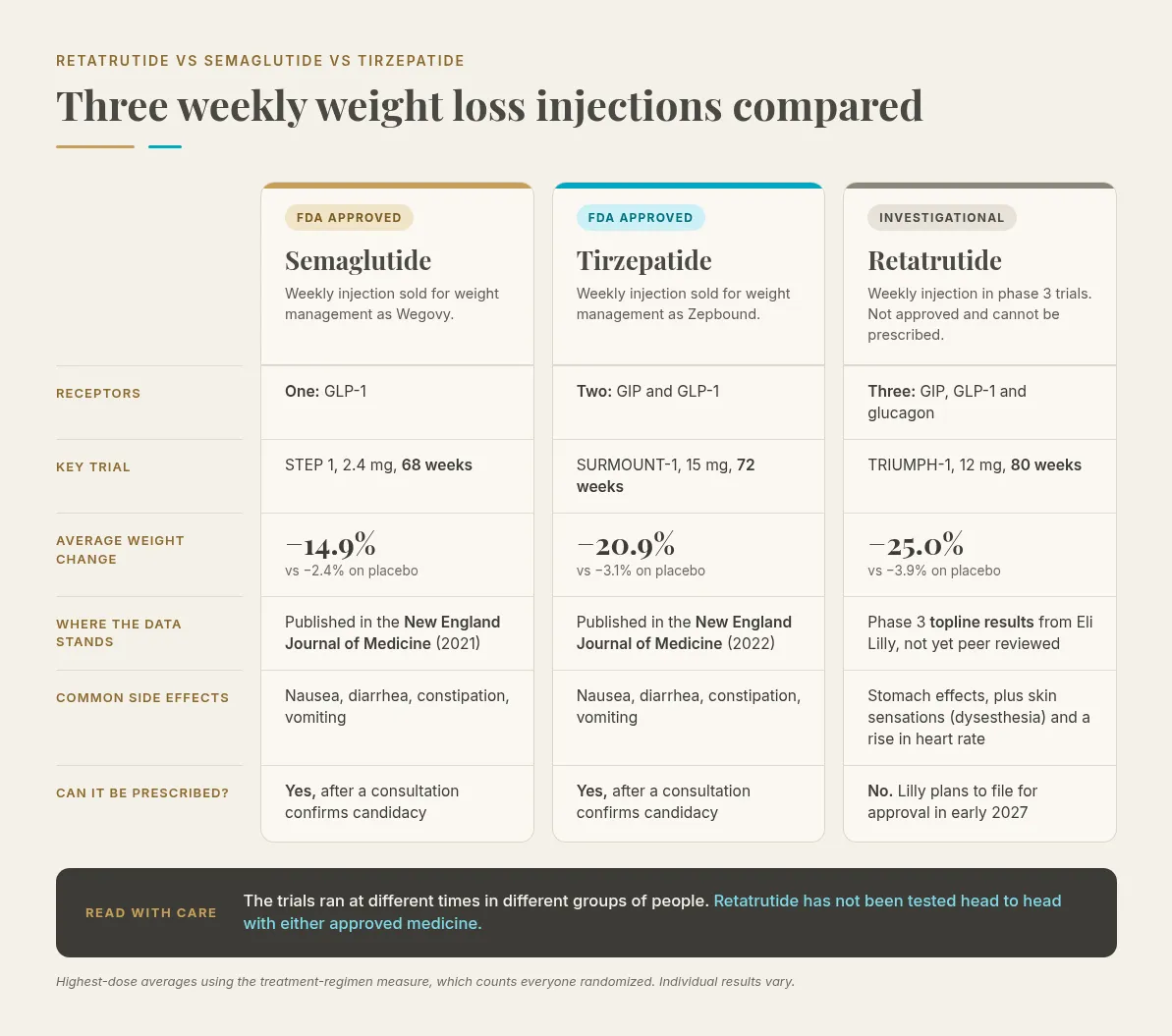
Read this chart with care. The trials ran at different times, in different populations, and for different lengths, so a higher number in one column does not prove one drug works better than another. Tirzepatide and semaglutide have been compared directly: in the SURMOUNT-5 trial, adults on tirzepatide lost an average of 20.2% of body weight at 72 weeks, against 13.7% on semaglutide. Retatrutide has not yet been tested head to head with either one, and its phase 3 results have not been peer reviewed.
For people considering treatment today, semaglutide and tirzepatide are the approved options. Both have years of real-world safety data that retatrutide does not have yet. The National Institutes of Health keeps a plain-language overview of prescription weight loss medicines, including who they are approved for and their common side effects.
What are the side effects of retatrutide?
The most common side effects in the trials resemble those of other GLP-1 based medicines. They are mostly stomach related and tend to show up while the dose is being raised.
- Stomach effects: In TRIUMPH-1, nausea affected 28.6% to 42.4% of people on retatrutide, against 14.8% on placebo. Diarrhea, constipation, and vomiting were also more common than on placebo.
- Dysesthesia: This is an unusual skin sensation, such as tingling, burning, or sensitivity to touch. In TRIUMPH-1 it affected 5.1% to 12.5% of retatrutide participants, against 0.9% on placebo. In TRIUMPH-4 it affected up to 20.9% at the 12 mg dose. Most cases were reported as mild.
- Heart rate: In the phase 2 trial, heart rate rose in a dose-dependent way up to 24 weeks and then declined. Reported arrhythmias were mostly mild to moderate.
- Stopping treatment: In TRIUMPH-1, 4.1%, 6.9%, and 11.3% of people on the 4 mg, 9 mg, and 12 mg doses stopped because of side effects, against 4.9% on placebo. In TRIUMPH-4 the rates were higher, at 12.2% for 9 mg and 18.2% for 12 mg, and Lilly noted that some of those people stopped because they felt they were losing too much weight.
The phase 2 trial reported serious adverse events in 4% of both the retatrutide and placebo groups. Long-term safety data are still being collected.
Is retatrutide FDA approved?
No. Retatrutide has not been approved by the FDA or by any other regulator. Eli Lilly announced in July 2026 that it plans to submit an application in the first quarter of 2027, and the FDA review itself takes months after submission. Regulatory status can change, so the primary sources listed at the end of this article are the place to check for updates.
The doses in the trials (1 mg to 12 mg once a week) describe what researchers tested. They are not dosing guidance, because no approved label exists yet.
Is it safe to buy retatrutide online?
No. Strong trial results and a long wait for approval created demand, and online sellers filled it. Many list retatrutide as a “research chemical” or “for research use only.”
The FDA does not treat that label as a loophole. In a March 2026 warning letter, the agency told one such seller that its retatrutide products were unapproved new drugs, and that “research use only” wording did not change that because the products were being marketed for human use. The agency has also warned more broadly about unapproved GLP-1 drugs, noting that they have not been reviewed for safety, effectiveness, or quality.
Injectable products carry added risk. An unregulated vial can contain the wrong dose, contamination, or other ingredients, and no physician screens the person injecting it. The FDA advises getting a prescription from a licensed physician and filling it at a state-licensed pharmacy, which is not possible for a drug with no approval.
How can you get retatrutide today?
For most people, retatrutide is not available today. There are three realistic paths for anyone interested in it:
- Join a clinical trial. Retatrutide studies are listed on ClinicalTrials.gov, the federal registry of research studies, with eligibility rules for each one.
- Wait for the FDA decision, which will come with full trial publications and an official label.
- Talk with a physician about an approved option such as semaglutide or tirzepatide, and whether either fits your health history.
Medication is also only part of the picture. In the trials, participants were counseled on diet and physical activity, and keeping weight off over the long term depends on habits as well as medication. Our guide to peptides for weight loss covers the supporting options people often ask about alongside GLP-1 medicines.
Key terms
- Agonist: a drug that activates a receptor.
- Efficacy estimand: a way of analyzing a trial that estimates results as if everyone had stayed on treatment.
- Investigational: still being tested in clinical trials and not approved for general use.
- Placebo: an inactive treatment used as a comparison in a trial.
- Dysesthesia: an unpleasant, abnormal sensation of the skin.
Starting an approved weight loss medication at Medrein
Retatrutide’s trial results are promising, and the full picture will become clearer once the phase 3 data are published and the FDA has made its decision. Until then, the medicines that can be prescribed are semaglutide and tirzepatide.
At our Southlake clinic, Dr. Mikki goes over your health history, current medications, and goals, explains the common side effects of each approved option, and confirms whether you are a candidate before anything is prescribed. If you are ready to talk it through, book a consultation with Dr. Mikki.
Retatrutide Peptide: Your Questions Answered
What is retatrutide?
Retatrutide is an investigational once-weekly injection developed by Eli Lilly. A single molecule activates three receptors: GIP, GLP-1, and glucagon. It is being tested for obesity, type 2 diabetes, knee osteoarthritis pain, and sleep apnea.
Is retatrutide FDA approved?
No. Retatrutide has not been approved by the FDA for any use. Eli Lilly has said it plans to submit an approval application in the first quarter of 2027, so a decision is not expected before then.
How much weight did people lose on retatrutide in clinical trials?
In the phase 2 trial, the 12 mg group lost an average of 24.2% of body weight at 48 weeks, compared with 2.1% on placebo. In the phase 3 TRIUMPH-1 trial, the 12 mg group lost an average of 28.3% at 80 weeks, compared with 2.2% on placebo. Results are averages and individual results vary.
What are the side effects of retatrutide?
The most common are nausea, diarrhea, constipation, and vomiting, which occur mainly while the dose is being increased. Trials also reported dysesthesia (unusual skin sensations such as tingling or sensitivity) and a dose-related rise in heart rate that eased after about 24 weeks in the phase 2 trial.
Is retatrutide different from semaglutide and tirzepatide?
Yes. Semaglutide activates the GLP-1 receptor, tirzepatide activates GIP and GLP-1, and retatrutide adds the glucagon receptor. Semaglutide and tirzepatide are FDA approved for weight management. Retatrutide is not.
Is it safe to buy retatrutide online?
No. Retatrutide sold online as a research chemical is not an approved product and has not been reviewed for safety, strength, or sterility. The FDA has warned companies selling it, including products labeled for research use only. The agency also says retatrutide cannot be used in compounding under federal law.
Can I get retatrutide before it is approved?
Only in very limited cases. Outside a clinical trial, the one route is a narrow early-access pathway: in August 2026, Lilly announced it for patients with severe obesity and serious complications, and physicians apply for it through the company. For everyone else, the practical step is to ask a physician whether an approved medication fits.
Sources & references
- Jastreboff et al., NEJM 2023: Triple-Hormone-Receptor Agonist Retatrutide for Obesity (phase 2)
- Eli Lilly, TRIUMPH-1 topline results (May 2026)
- Eli Lilly, TRIUMPH-2 and TRIUMPH-3 topline results (July 2026)
- Eli Lilly, TRIUMPH-4 topline results (December 2025)
- BioPharma Dive: Lilly to seek FDA approval of retatrutide
- AJMC: Lilly expands retatrutide access amid doctor pushback
- FDA warning letter to Gram Peptides (March 2026)
- FDA: Concerns with unapproved GLP-1 drugs used for weight loss
- Jastreboff et al., NEJM 2022: Tirzepatide Once Weekly for the Treatment of Obesity (SURMOUNT-1)
- Wilding et al., NEJM 2021: Once-Weekly Semaglutide in Adults with Overweight or Obesity (STEP 1)
Reviewed for accuracy per our editorial policy.
Ask Dr. Mikki about FDA-approved GLP-1 options
Dr. Mikki reviews your history and talks through semaglutide and tirzepatide, the approved medications, before anything is prescribed.
Related Articles

Why Southlake Patients Choose MedRein Over Ideal Image for Semaglutide
Why Southlake patients pick Medrein over national semaglutide chains for physician-supervised dosing, monthly monitoring, and integrated weight-loss care.

5 Essential Questions to Ask Your Semaglutide Weight Loss Provider
Five questions to ask before starting semaglutide for weight loss. Dr. Mikki at Medrein in Southlake shares what real physician oversight looks like.

Medical Weight Loss with GLP-1: Our Physician-Supervised Coaching Approach
GLP-1 medical weight loss in Southlake, TX with physician-supervised coaching at Medrein. Real accountability, personalized dosing, and lasting results.