Peptides for Weight Loss: How They Work & Who They're For

Medically reviewed by:

Founder & Medical Director
Are weight-loss peptides right for you?
Dr. Mikki reviews your history, screens whether a GLP-1 or supportive peptide fits, and sets a monitored plan.
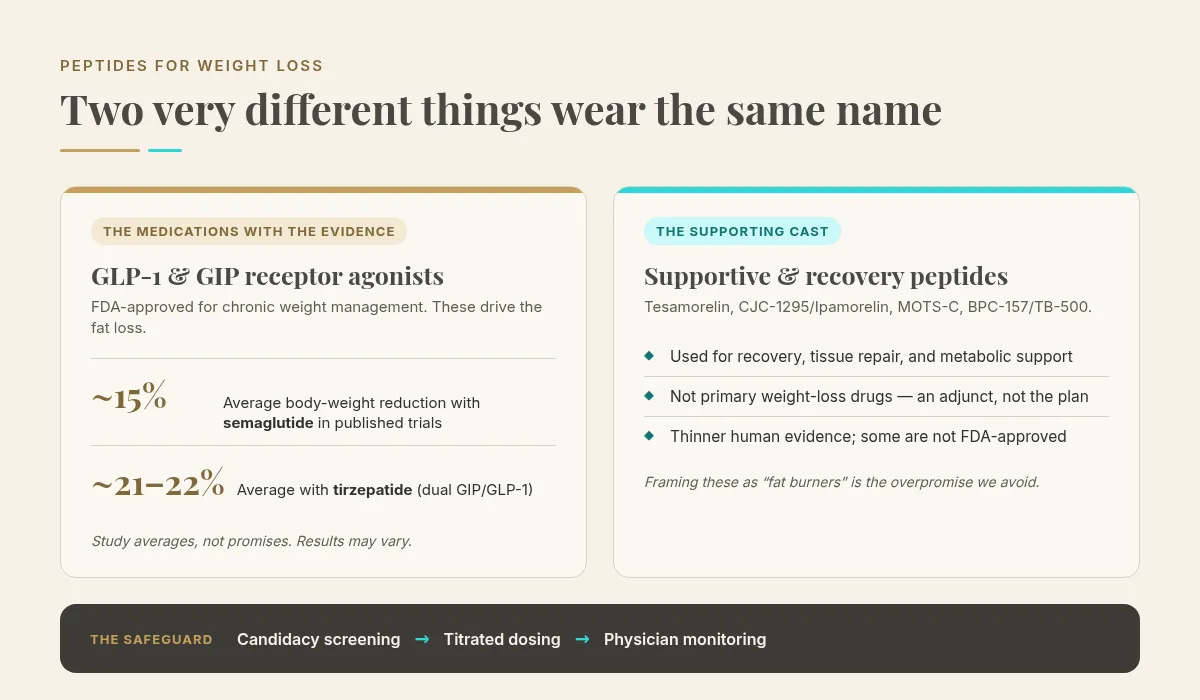
Book a Peptide Therapy ConsultationSearch “peptides for weight loss” and you get two answers wearing the same name. One is a class of medications, GLP-1 and GIP receptor agonists, that is genuinely reshaping metabolic medicine. The other is a wider field of recovery and metabolic peptides where the human evidence is thinner and the marketing is louder. Telling them apart is the whole point, because the difference decides both your safety and your results.
We built this guide to do what a product page can’t: explain what each kind actually does, who is a candidate, and why a board-certified physician belongs in the decision. If you want the treatment overview instead of the science, our peptide therapy service page covers the full menu. Read this first, though, because the honest version of this topic has a few sharp edges.
What peptides are, and how they affect weight
A peptide is a short chain of amino acids that acts as a signal in the body, telling cells and organs what to do. Some peptides mimic hormones that govern hunger and blood sugar. Others nudge tissue repair or metabolism. Grouping every one of these under “peptides for weight loss” is where most articles go wrong, so we separate them cleanly, the same way our peptide therapy program does before anything is prescribed.
GLP-1 and GIP: the metabolic medications
The peptides with real weight-loss evidence are the incretin medications. Semaglutide is a GLP-1 receptor agonist, a molecule that closely mimics a natural gut hormone your body already makes after eating.
These medications work on appetite regulation: they slow how fast the stomach empties and quiet the hunger and “food noise” signals in the brain, so you feel full on less. In published trials, semaglutide averaged around 15% body-weight reduction and the dual GIP/GLP-1 medication tirzepatide averaged roughly 21–22%. These are study averages, not promises for any one person. Results may vary.
Supportive and recovery peptides
The second group is different. Peptides like Tesamorelin, CJC-1295 / Ipamorelin, MOTS-C, and the BPC-157/TB-500 pairing are used for recovery, tissue repair, or metabolic support, not as primary weight-loss drugs.
Some, like Tesamorelin, have specific approved uses and are studied for visceral fat; others are earlier in the evidence curve. BPC-157, for instance, is not FDA-approved and lacks strong human clinical evidence, so we discuss it in mechanism terms and candidacy terms only, never as a fat-loss guarantee. Framing these as “fat burners” is exactly the overpromise we avoid.
Where these peptides can matter is around a weight-loss plan rather than as the plan. During rapid loss, protecting muscle and supporting recovery are real goals, and that is the honest lane for the recovery peptides: a physician-chosen adjunct that supports the plan the medication drives. When you ask us for the best peptide stack for fat loss, the honest answer is that the medication does the work, and any supportive peptides play a supporting part your physician decides on.
The medications and peptides people ask about
Searchers usually arrive with a specific molecule name in mind. The table below orients you to the ones we’re asked about most, in mechanism language: what each is intended to support, not what it will deliver for you.
| Molecule / stack | Category | What it’s intended to support | Physician note |
|---|---|---|---|
| Semaglutide | GLP-1 agonist | Appetite reduction, blood-sugar signaling | FDA-approved for chronic weight management |
| Tirzepatide | GIP + GLP-1 agonist | Appetite reduction, stronger metabolic effect | FDA-approved; activates two incretin receptors |
| Tesamorelin | GH-releasing peptide | Visceral-fat and body-composition support | Approved for specific indications; adjunct, not a weight-loss drug |
| CJC-1295 / Ipamorelin | GH secretagogues | Recovery, body composition | Supportive role; physician-supervised |
| Wolverine Stack (BPC-157/TB-500) | Recovery peptides | Tissue repair and recovery | Not weight-loss drugs; limited human evidence |
Tirzepatide is FDA approved for chronic weight management and is the first medication to activate both the GIP and GLP-1 receptors. And when you ask us about the recovery peptides, the honest answer lives on our Wolverine Stack page: useful for recovery while the metabolic medication does the weight work.
Who peptides for weight loss are actually for
Here is the part almost no article covers, and the part that matters most. When people search “peptides for weight loss,” they rarely expect this answer: a peptide or GLP-1 medication is a medical treatment, so being a candidate is a clinical decision, not a checkbox on a checkout page. We decide it in a consultation, because the right answer depends on your health history.
You may be a good candidate if your weight has not moved with sustained diet and exercise, if you carry weight-related metabolic concerns, and if you want your care screened and monitored by a physician. You may not be a candidate, or may need a different plan, if certain risks are present.
It also helps to arrive with realistic expectations. These medications are a long-term tool you stay on with a plan. The published trial averages come from months of supervised, titrated treatment paired with nutrition and activity, and weight can return if the medication stops without a maintenance plan. We talk through that arc at the consultation so you can decide whether it works for your daily life before you start.
Before prescribing a GLP-1 medication, we screen for a personal or family history of medullary thyroid cancer or MEN 2, a history of pancreatitis or gallbladder disease, pregnancy or plans to conceive, and the medications you already take. Those questions are the reasons a physician, not an algorithm, should make this call.
Candidacy for weight-loss peptides is decided at a consultation, after a health history and the right screening. It is never bought online. Every outcome discussed here can differ from person to person. Results may vary.
Because we treat the whole picture, a weight consultation often overlaps with other longevity care. If low energy, sleep, or vitality are part of the story, hormone therapy may belong in the same conversation, coordinated under one physician rather than scattered across clinics.
What side effects should you expect?
No effective medication is free of trade-offs, and honesty about them is part of good care. For the GLP-1 medications, the common side effects are gastrointestinal: nausea, constipation, diarrhea, and reflux, usually strongest early and easing as your body adjusts. Starting at a low dose and increasing slowly is how a physician keeps them manageable.
A smaller set of risks is serious but rare, and screening exists precisely to catch them. These are the reasons we ask about your full history at the start.
- Pancreatitis: we screen for a prior history and watch for warning signs.
- Gallbladder problems, which can surface with rapid weight change.
- A boxed warning tied to thyroid C-cell tumors in animal studies, which is why a personal or family history of medullary thyroid cancer or MEN 2 rules the medications out.
- Interactions with other medications, especially those for diabetes, which may need adjusting.
The supportive peptides carry a different, less-defined risk picture, largely because the human evidence is thinner. That uncertainty is a reason for physician oversight rather than a reason to self-source them. Whatever the plan, monitoring is what turns a known side-effect list into a managed one. Results may vary.
Why physician-led care is the safety mechanism
“Physician-supervised” gets said a lot in this industry and shown very little. What it actually means is concrete: a candidacy screen before anything is prescribed, a dose started low and titrated up to manage side effects, and follow-up that catches problems early. Those steps are the difference between medical care and a vial in the mail.
That is also why the shortcuts worry us. Compounded and gray-market GLP-1 products used without oversight carry real compounded risks: unknown purity and no one watching for the side effects that need managing. A pop-up clinic that ships a pen has no way to handle what comes next.
Medrein is physician-led, not physician-supervised on paper. Dr. Mikki, a board-certified MD with an ER background, personally conducts consultations and manages the protocol, so a physician who knows your case handles the dosing and anything that comes up. That is the safeguard the mail-order model removes.
The honest path to medically supervised weight loss
“Peptides for weight loss” is really two categories: evidence-backed GLP-1 and GIP medications that drive fat loss, and supportive peptides that play a smaller, different role. The safe route through either is a physician who screens your candidacy, starts you correctly, and monitors how you respond.
If you have tried to lose weight on your own and want a medically supervised plan built around your health, book a consultation at Medrein. We’ll review your history and tell you honestly if you’re a candidate, with no obligation and no vial shipped without a physician behind it.
Peptides for Weight Loss: Your Questions Answered
Are peptides for weight loss safe?
Safety depends on the specific peptide, your health history, and whether a physician is screening and monitoring you. FDA-approved GLP-1 medications have well-studied safety profiles when prescribed and supervised. Gray-market or mail-order products carry unknown purity and no oversight. A consultation determines whether a given option is safe for you.
Which is the best peptide for weight loss?
There is no single best one. The GLP-1 and GIP medications carry the strongest clinical evidence for weight, while supportive peptides play a different role. Which fits depends on your candidacy, health history, and goals, and that is decided in a consultation, not online. Results may vary.
How long do peptides take to work for weight loss?
It varies by person, by medication, and by how a physician titrates your dose. GLP-1 medications are typically started low and increased gradually to manage side effects, so changes unfold over weeks to months under monitoring. We set expectations at your consultation. Results may vary.
How much does peptide therapy for weight loss cost?
Cost depends on the specific protocol and how long you stay on it, so pricing is set at consultation rather than listed as a flat rate. We review the options and what is involved before anything is scheduled, with no obligation to proceed.
Can supportive peptides be combined with a GLP-1 medication?
Sometimes, but only as a physician's call. A GLP-1 or GIP medication does the weight-loss work, and a supportive peptide may be added to help protect muscle or support recovery during rapid loss. Whether an adjunct makes sense depends on your health history and goals, so it is decided at your consultation, never stacked on your own. Results may vary.
What happens if I stop taking a GLP-1 medication?
Weight can return when a GLP-1 medication stops without a maintenance plan, because the appetite signals it quiets come back. That is why we treat these medications as a long-term tool and plan the nutrition, activity, and follow-up that support maintenance before you start. Any change to your dose is made with your physician. Results may vary.
Sources & references
Reviewed for accuracy per our editorial policy.
Are weight-loss peptides right for you?
Book a consultation and Dr. Mikki reviews your health history, screens whether a GLP-1 or supportive peptide fits your case, and sets a starting dose that's monitored throughout, with no obligation.
Related Articles

The Wolverine Peptide Stack: A Physician's Guide to Accelerated Recovery and Cellular Repair
Frustrated with slow recovery? A physician explains the wolverine peptide stack for safe, accelerated healing and cellular repair. Learn how it works.

Peptide Therapy vs Traditional Anti-Aging: Which Delivers Real Results in Southlake
Compare how peptide therapy works versus traditional anti-aging treatments in Southlake. Dr. Mikki explains protocols, timelines, and physician-supervised care.

Discover Where to Find MOTS-C Near Me in Southlake, TX
MOTS-C peptide therapy at Medrein in Southlake, TX: how this mitochondrial peptide supports metabolism, energy, and healthy aging.