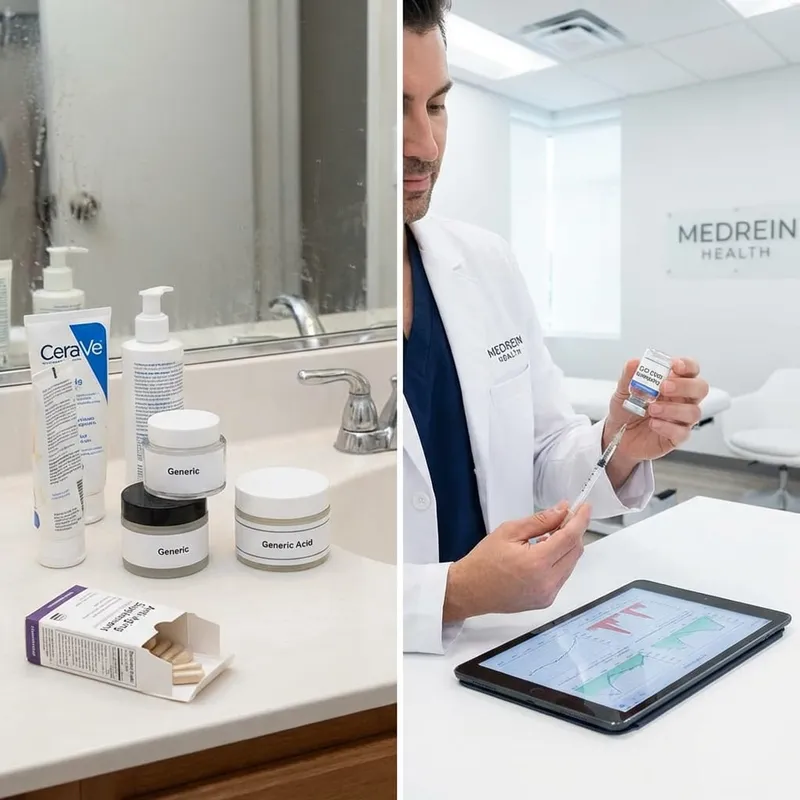
GHK-Cu: Topical vs Injectable Evidence, Risks & FDA Status
GHK-Cu (copper peptide) explained: what the skin and hair studies show, side effects, current FDA status and a topical vs injectable chart. Book a consultation.
A protocol for recovery, energy, immunity, or focus, matched to the patient
Ten articles on peptide therapy at Medrein, covering distinct protocols for recovery, energy, immune support, and cognitive focus and who each one suits.
Peptide therapy is not one treatment; it is a set of distinct compounds, each signaling the body toward a different outcome. This archive groups its articles by what a peptide actually does: recovery peptides like BPC-157 and TB-500 (the Wolverine Stack) for tissue repair, energy peptides like NAD+, MOTS-C, and SS-31 for mitochondrial function, Thymosin Alpha-1 for immune regulation, and Selank and Semax for focus and stress response. Each article explains how that specific protocol is built, from baseline labs through ongoing check-ins, and who tends to be a candidate.
Because these are prescription and compounded peptides, candidacy, dosing, and duration are all determined individually by a physician after a consultation and relevant labs. Some peptides discussed here, including BPC-157 and TB-500, currently sit in a shifting regulatory landscape for compounding, which the relevant articles note directly. This archive explains what each protocol involves; it does not set expectations about how quickly or how much a given patient will respond.
GHK-Cu (copper peptide) explained: what the skin and hair studies show, side effects, current FDA status and a topical vs injectable chart. Book a consultation.
Peptides for muscle growth compared: growth hormone peptides vs recovery peptides, rated by evidence with FDA and WADA status in one chart. Book a consultation.
Tesamorelin explained by a Southlake MD: what the FDA label says, side effects, who qualifies, and a week-by-week results timeline chart. Book a consultation.
How do peptides for weight loss actually work, and which ones are physician-supervised? A board-certified MD explains the real options and who is a candidate.
Frustrated with slow recovery? A physician explains the wolverine peptide stack for safe, accelerated healing and cellular repair. Learn how it works.
Compare how peptide therapy works versus traditional anti-aging treatments in Southlake. Dr. Mikki explains protocols, timelines, and physician-supervised care.
MOTS-C peptide therapy at Medrein in Southlake, TX: how this mitochondrial peptide supports metabolism, energy, and healthy aging.
The Wolverine Stack explained: what BPC-157 and TB-500 each do, how dosing is set, side effects, who should avoid it, and a side-by-side chart. Book a consult.
CJC-1295 peptide therapy in Southlake, TX combines growth hormone optimization with Ipamorelin for fat loss and muscle gain. Physician-supervised at Medrein.
NAD+, MOTS-C, and SS-31 energy peptides in Southlake, TX: physician-supervised mitochondrial therapy for fatigue, brain fog, and declining energy levels.
Selank and Semax nootropic peptides in Southlake, TX: physician-supervised protocols for focus, memory, and anxiety reduction at Medrein.
Wolverine Stack, Glow 70, and Klow 80 pair TB-500 and BPC-157 with GHK-Cu and KPV for healing, anti-aging, and gut health at Medrein in Southlake, TX.
Thymosin Alpha-1 peptide therapy in Southlake, TX. Physician-supervised immune support at Medrein. Learn how it works and who it helps.
Learn how long IV therapy stays in your body, from fast-absorbed fluids to nutrients that can linger for weeks, and what factors affect how long it lasts.
No. Peptide therapy covers several distinct categories, including recovery peptides for tissue repair, energy peptides for mitochondrial support, immune peptides, and cognitive peptides for focus and stress. Each works through a different mechanism, so the right one depends on the specific concern a patient brings to consultation.
Protocols typically start with baseline labs and a review of medical history, health goals, and any contraindications. From there, a physician selects the peptide or combination, sets a starting protocol, and schedules follow-up checks to monitor response and adjust as needed.
Not exactly. Many peptides are prescription compounds filled through regulated compounding pharmacies, and the regulatory landscape for some of them is actively evolving. Our articles note current status where it is relevant, but candidacy and legality can change, which is why this is discussed during consultation rather than assumed from an article.
Every peptide protocol at Medrein begins with baseline labs and a physician consultation, and is monitored on an ongoing schedule rather than dispensed as a fixed, generic order.
Made by FOMO.ai