Preventative Botox: What Age to Start and Does It Work

Medically reviewed by:

Founder & Medical Director
Is preventative Botox right for you?
Dr. Mikki looks at your face at rest and in motion and tells you honestly whether an early line is ready to treat.
Book an Injectables ConsultationPreventative Botox is the term for using a neurotoxin, such as Botox, Dysport, or Newtox/Jeuveau, while a facial line still only shows up when you raise your eyebrows or frown. The idea is about timing: softening the repeated muscle movement that creates a line early, before it settles into a crease you can see with your face at rest.
Search interest in the term has grown quickly among patients in their twenties and early thirties, and the honest answer is more nuanced than a single age cutoff. This guide covers what preventative Botox actually means, which neurotoxins Medrein carries, what the FDA has and hasn’t approved it for, and what a first consultation involves.
What preventative Botox actually means
Preventative Botox describes timing, not a different treatment. The neurotoxin injections Medrein offers work by temporarily relaxing the muscle that folds the skin into a line. Used after a crease has set into the skin at rest, that same injection softens an existing line. Used earlier, while the line only appears when the muscle moves, it can help slow how quickly that movement leaves a lasting mark.
The term covers the same products and the same mechanism. What changes is when you start treatment and how conservatively Dr. Mikki doses the area.
The three neurotoxins Medrein carries
Botox is a brand name for onabotulinumtoxinA, one specific neurotoxin made by one manufacturer. This guide uses “neurotoxin” whenever it’s describing the whole category and names the specific product when it matters. Medrein carries three: Botox, Dysport, and Newtox, also sold as Jeuveau. If you want a closer look at how two of them compare, our guide to Jeuveau and Botox walks through onset, cost, and FDA approval history for each.
All three belong to the same class of molecule, botulinum toxin type A. Dr. Mikki chooses between them based on the area being treated, how that muscle moves, and how quickly you want to see a change.
What age should you start preventative Botox?
There’s no official starting age for preventative Botox, and no medical body publishes one. The American Society of Plastic Surgeons frames the decision around what the face is doing: early, lingering dynamic lines and strong repetitive muscle movement, not a birthday. Some patients see that pattern in their late twenties. Others don’t see it until their forties, and plenty of patients with faint lines never pursue treatment at all.
Dr. Mikki looks at your face at rest and while you move it: frowning, raising your eyebrows, smiling. If a line only appears during movement and starts to linger a little longer each time, that’s the pattern preventative treatment addresses. If your skin stays smooth once you relax your expression, there isn’t yet a line to treat, and starting for its own sake isn’t a standard any professional body recommends.
What is “baby Botox”?
“Baby Botox” is a patient term, not a clinical one, for a lower, more conservative dose of the same neurotoxin, placed to soften movement without stopping it. The name describes the dose, not a different or weaker product. Dr. Mikki uses the same Botox, Dysport, or Jeuveau either way, adjusted to the muscle and the result you want.
Medrein’s approach already doses conservatively for patients who want a first result that nobody can spot. The goal is a face that still moves and still looks like your own, with the line softened. That matters most on a first treatment, when a heavier hand is harder to recognize as yourself.
Does preventative Botox actually work?
The honest answer depends on what “work” means. Relaxing the muscle reduces the movement that folds the skin, so a dynamic line that only shows up with expression shows up less. That mechanism is well established. Whether starting earlier prevents every future wrinkle is a different question, and the answer there is no, because sun exposure, genetics, and volume loss also drive facial aging, and a neurotoxin addresses none of them.
Early research, including a systematic review of preventive botulinum toxin use, suggests that treating a dynamic line earlier may slow how quickly it becomes a static one, though the authors note the studies are small and the long-term picture isn’t settled. The American Society of Plastic Surgeons reaches a similar conclusion: timing and restraint make more difference than any target age, and a line with no movement behind it isn’t a reason to treat. Dr. Mikki follows the same read of the evidence, so she won’t recommend treating skin that is already smooth just because a patient asks for it.
Can you start preventative Botox too early?
Yes, in the sense that a dose placed where there’s no repetitive movement to soften doesn’t accomplish much. Plastic surgeons interviewed by the American Society of Plastic Surgeons point to two separate concerns with treating before any line exists: there’s little for the neurotoxin to actually do, and repeatedly treating the same muscle over years can eventually cause it to thin, which can make a full range of movement harder to regain later. Neither concern applies to the conservative, early-but-present-line treatment this guide describes. Both apply to treating smooth skin on a schedule because a trend suggested it.
Dr. Mikki’s standard matches what those specialists describe: treat a need you can see at your consultation, not a routine a trend recommends. If your face is smooth at rest and stays smooth once your expression relaxes, she’ll tell you that plainly, even when that means recommending you wait.
A neurotoxin is also only one part of keeping skin looking healthy over time. Daily sunscreen, a simple skincare routine, and avoiding smoking all affect how quickly new lines form in the first place, with or without treatment.
Which lines Botox is FDA-approved to treat
The FDA prescribing information for Botox lists four approved cosmetic uses, all described as moderate to severe: glabellar lines, the frown lines between the brows, approved in 2002; lateral canthal lines, better known as crow’s feet, approved in 2013; forehead lines, approved in 2017; and platysma bands, the vertical neck bands connecting the jaw and neck, approved in 2024.
Using Botox on a face that doesn’t yet have a visible line in one of those areas isn’t a separately approved use. That doesn’t make early, conservative treatment of an emerging dynamic line unsafe or improper. It means the “prevent every future wrinkle” framing some patients bring to a first consultation goes further than what the FDA has evaluated, and Dr. Mikki says so plainly at your consultation.
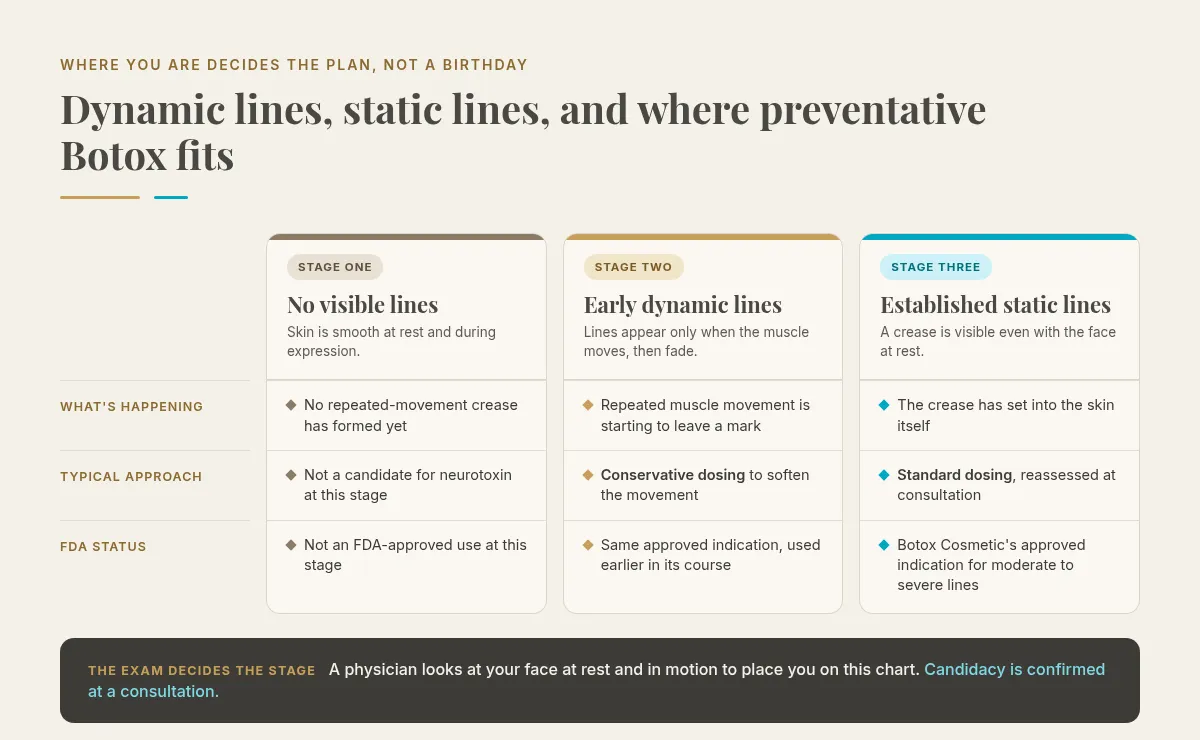
According to the American Academy of Dermatology, most patients see an initial change within three to seven days, and the improvement typically lasts about three to four months before the treated muscle regains its full movement. Dysport and Jeuveau carry their own FDA approvals for frown lines specifically, with different onset and spread than Botox. If you’re weighing Botox and Dysport against each other for the forehead, that comparison covers onset, duration, and how each product spreads once it’s placed.
How much does preventative Botox cost?
Medrein doesn’t publish a per-unit price for Botox, Dysport, or Jeuveau, so the amount you pay depends on the product, the area, and how many units your plan needs. That’s set at your consultation.
The Beauty Club membership brings the ongoing cost down for patients who plan to treat the same area every few months: $100 a month includes $9-per-unit pricing on Jeuveau and $50 off fillers. Dr. Mikki can walk you through whether a membership or a single treatment makes more sense once she knows your plan.
What happens at a first Botox consultation
A first appointment starts with Dr. Mikki looking at your face at rest and in motion, the same assessment that decides whether early treatment is appropriate at all. She asks about your medical history and what specifically bothers you, then explains, area by area, what a conservative dose would and wouldn’t change.
If you move forward the same day, the injection itself takes a few minutes with a very fine needle. Most patients return to normal activity right away, avoiding strenuous exercise and lying flat for a few hours. The first change usually shows up within three to seven days, with the full effect settling in by about two weeks. Results may vary.
A little preparation goes a long way toward a smoother first appointment and less bruising afterward. Our pre-injection habits guide covers what to do, and what to avoid, in the days before you come in.
Who should wait on neurotoxin treatment
Neurotoxin injections aren’t right for everyone, at any age. Dr. Mikki postpones treatment if you’re pregnant or breastfeeding, and she doesn’t recommend it if you have a neuromuscular condition such as myasthenia gravis, vision problems like double vision, or a known allergy to an ingredient in the product. None of these checks are specific to starting early. They apply before any neurotoxin treatment, and Dr. Mikki goes through them at your consultation regardless of your age.
Preventative Botox is a timing choice, not a separate product or a guarantee against future lines. Dr. Mikki confirms candidacy, and the plan that fits it, at a consultation. Results may vary.
Getting started with preventative Botox at Medrein
Preventative Botox works best as a response to an early pattern already showing in your face, not a routine you start on a fixed schedule. Whether that pattern exists, and which neurotoxin and dose fit it, is something Dr. Mikki can tell you after one appointment.
If you’ve noticed a line that only shows up when you raise your eyebrows or frown, and you want an honest opinion on whether now is the time to treat it, book a consultation at our Southlake clinic. Dr. Mikki will look at your face before recommending anything.
Preventative Botox FAQs
What age should I start preventative Botox?
There's no official starting age. The American Society of Plastic Surgeons frames candidacy around what your facial muscles are doing: early, lingering dynamic lines and strong repetitive movement, not a birthday. Some patients see that pattern in their late twenties, others later, and Dr. Mikki confirms it by looking at your face at rest and in motion at your consultation.
Is preventative Botox different from regular Botox?
No. It's the same Botox, Dysport, or Jeuveau, used earlier in a line's life and dosed conservatively, while the line only appears during movement instead of staying visible at rest. The product and the mechanism don't change.
What is baby Botox?
Baby Botox is a patient term for a lower, conservative dose, not a separate or weaker product. Dr. Mikki uses it to soften a line while your face still moves naturally, which is the approach most first-time patients want.
Does preventative Botox actually work?
The mechanism is established: relaxing the muscle reduces the movement that creates a line, so an early dynamic line shows up less. Whether starting earlier slows a line's long-term progression is still being studied, and a neurotoxin doesn't address other drivers of facial aging, such as sun exposure and volume loss. Results may vary.
How much does preventative Botox cost?
Medrein doesn't publish a per-unit price for Botox, Dysport, or Jeuveau, so your cost depends on the product and how many units your plan needs, and you receive a quote at your consultation. Beauty Club members pay $9 per unit on Jeuveau for $100 a month.
Will preventative Botox make me look frozen?
No. Treating a line early and conservatively is meant to keep the muscle moving naturally, not freeze it. Dr. Mikki keeps the dose light enough that your expression still looks recognizably yours, and if you'd prefer a stronger effect later, the plan can build toward it over future visits.
Is it safe to start neurotoxin injections in my 20s?
Yes. Botox, Dysport, and Jeuveau are approved for adults 18 and over, and side effects at any age are generally the same: temporary swelling, redness, bruising, or a mild headache at the injection site. Dr. Mikki reviews your medical history at consultation to confirm you're a candidate before anything is injected.
Wondering if an early line is worth treating yet?
Book a consultation and Dr. Mikki will examine your face, explain what she sees, and give you a straight answer, plus a quote, before anything is injected.
Related Articles
Cheek Filler: How Long It Lasts, Cost & Sculptra vs HA
Cheek filler from a Southlake MD: which fillers are FDA-approved for cheeks, how long each lasts, plus a hyaluronic acid vs Sculptra chart. Book a consultation.
Under Eye Filler: Candidacy Chart, Recovery and Side Effects
Under eye filler by a Southlake MD: a chart of which under-eye concerns filler suits, FDA-approved options, side effects and recovery. Book a consultation.

Physician's Guide to Facial Biostimulator Injections
A physician explains facial biostimulator injections: how Sculptra and Radiesse trigger your own collagen production for natural, longer-lasting results.