10 Things to Know Before Getting Dermal Fillers in Southlake

Medically reviewed by:

Founder & Medical Director
Thinking about dermal fillers?
Dr. Mikki looks at your facial proportions and tells you which filler suits each area, and which areas to leave alone.
Book an Injectables ConsultationDermal fillers are one of the most common minimally invasive cosmetic treatments in the United States. They restore volume that has thinned with age and add shape to the lips, cheeks and chin, and an appointment usually takes under an hour.
Filler is still a medical procedure, and the choices you make before the first syringe shape the result. These ten points cover the filler types, how long each one lasts, the side effects, the cost and who should wait.
1. What dermal fillers are
Dermal fillers are soft, gel-like implants injected beneath the skin to restore volume and smooth lines. Every product used in our Dermal Fillers treatments is FDA-approved. The FDA regulates fillers as medical devices and approves each product for specific uses, such as moderate to severe facial wrinkles and folds and adding volume to the lips, cheeks, chin and the backs of the hands.
The areas treated most often are the lips, cheeks, under-eye hollows, nasolabial folds (the smile lines from nose to mouth), marionette lines, the chin and the jawline. Dr. Mikki also treats the temples, the neck and décolletage, and the hands.
Filler replaces lost volume. Adding more product to a loose, sagging cheek tends to make the face look heavier, so when the concern is laxity, energy-based tightening or a collagen-building treatment is usually the better tool.
2. There are four main types of filler material
Fillers are grouped by what they are made of, because the material decides how the filler behaves and how long it stays. The American Society of Plastic Surgeons describes the same main families:
- Hyaluronic acid (HA) is a sugar your skin already makes. HA fillers give volume straight away, hold water in the tissue and can be dissolved.
- Calcium hydroxylapatite (CaHA) is a mineral-like compound also found in bone. Radiesse is the best-known brand, and it gives some volume on the day while prompting new collagen.
- Poly-L-lactic acid (PLLA) is a biodegradable material, sold as Sculptra, that stimulates collagen gradually over a few sessions.
- Polymethylmethacrylate (PMMA) microspheres, sold as Bellafill, are held in a collagen gel. The collagen is absorbed and the microspheres stay to support the tissue.
Medrein carries four HA lines: Juvéderm, Restylane, RHA and Revanesse Versa. Radiesse, Sculptra and Bellafill are collagen stimulators, so we group them under Biostimulators and plan them differently.
3. How to know which dermal filler to try
The right filler depends on the area, the depth and the look you want. Each brand makes gels of different thickness. Thinner, softer gels suit the lips and fine lines, and firmer gels give support where there is bone underneath, such as the cheekbones and the jaw.
For the cheeks, firmer formulas such as Juvéderm Voluma XC and Restylane Lyft restore midface volume. Our guide to cheek filler explains how the cheek is assessed and how much product it usually takes. The under-eye area is thinner and more delicate, and Restylane Eyelight is the formula made for it. Our article on under-eye filler covers who suits tear trough treatment and who is better served by something else. Along the jaw, a firmer gel adds definition to the jawline and chin, and our piece on jawline filler explains which formulas are used there and what the FDA has approved for that area.
You do not need to arrive knowing which brand you want. Dr. Mikki examines your facial proportions, explains what filler can and cannot do for the concern you came in with, and then chooses the family and the formula for each area.
4. Why people get dermal fillers
Most people come in because a feature has changed with age. Lips thin, cheeks flatten, under-eye hollows make a face look tired, and the folds around the mouth deepen. Filler restores that volume without surgery, and the change shows the same day.
Others want to add definition, such as a more balanced chin or a smoother lip border. Lines caused by muscle movement, such as frown lines and crow’s feet, respond better to a Neurotoxin, and many plans pair the two. Smile lines and hollows are the ones that respond to volume.
5. How to prepare before getting fillers
A few steps before the appointment lower the chance of bruising and help the plan go smoothly:
- Share your full medication list. Tell Dr. Mikki about blood thinners, pain relievers and supplements such as fish oil and vitamin E, which can increase bruising. Do not stop a prescribed medication on your own.
- Mention your health history. Bleeding or clotting disorders, autoimmune or connective tissue conditions, severe allergies and a history of keloid scarring all affect candidacy.
- Check your calendar. Filler is not placed within four weeks of a laser treatment, IPL, a Chemical Peel or dermabrasion. Leave a gap around dental work too, because the FDA notes that inflammation near a filler can follow dental procedures.
- Wait out any flare-up. An active breakout, cold sore, rash or infection near the treatment area means the appointment should be moved.
- Allow time before an event. Swelling and bruising can take up to a week to settle, so leave a margin before a wedding, a photo shoot or a trip.
6. Questions to ask at your filler consultation
A consultation is your chance to understand the plan before anything is injected. Useful questions include:
- Who will perform the injections, and what is their training?
- Which filler brand and formula will you use in each area, and why?
- How many syringes does the plan need, and what is the total cost?
- How long should I expect this filler to last in this area?
- What happens if I have a complication, and can this filler be dissolved?
The FDA also recommends that you read the patient labeling for the specific product you receive. At Medrein, Dr. Haritha Mikkilineni, MD, a board-certified physician, performs the consultation and injects herself. She will tell you if a feature is already proportionate and does not need filler.
7. Dermal filler side effects to know about
Most side effects appear shortly after treatment and settle within a few days to a week. The common ones are:
- Swelling
- Bruising
- Redness
- Tenderness or mild pain at the injection site
- Itching
Less often, small lumps or unevenness can form under the skin. With HA filler these can often be massaged or dissolved. Infection is rare. Filler can also migrate if too much product is placed, if technique is poor or if the area is pressed hard afterward.
The most serious risk is filler entering a blood vessel by accident, which can block blood flow. It is rare, and it is treated as an emergency. Contact the clinic straight away, or seek emergency care, if you notice unusual pain, vision changes, or skin that turns white, gray or blue near the injection site. Our aftercare guide covers what to do and avoid in the first 72 hours.
8. Who should avoid dermal fillers
When to wait or skip filler
Dermal fillers are not recommended during pregnancy or while breastfeeding, and the FDA approves them for adults 22 and older. Filler is also postponed with an active skin condition in the area, such as acne, rosacea, seborrheic dermatitis or psoriasis. People with a known allergy to hyaluronic acid, lidocaine or streptococcal proteins, a bleeding disorder, or a history of keloids or hypertrophic scarring need a careful discussion first. Bellafill is ruled out for anyone allergic to bovine collagen.
If any of these apply, it does not always mean filler is off the table for good. Dr. Mikki goes through your history at the consultation and tells you plainly whether filler suits you, or whether another treatment is the better fit.
9. How much dermal fillers cost at Medrein
Filler at Medrein is planned and priced by the syringe. Your total depends on the formula chosen for each area and how many syringes that area needs. Lips often need less product than the cheeks or jawline, and treating several areas at once takes more. Because prices differ from one formula to another, Medrein does not publish a per-syringe price list. Dr. Mikki gives you the plan and the total at your consultation, before anything is injected.
If you keep up with injectables through the year, a monthly membership can lower the cost. The Beauty Club and Glow Club include $50 off fillers, and the Laser Club includes 10% off fillers. Medrein’s rewards program also earns one point per dollar spent on services, and the 3,000-point and 10,000-point rewards include 20% and 50% off one filler. CareCredit is accepted at the Southlake clinic if you would like to spread the cost over time.
10. How long dermal filler results last
How long filler lasts depends on the material, the formula, the area and your metabolism. Areas that move a lot, such as the lips, tend to break filler down sooner than the cheeks or chin. The chart sets the families Medrein carries side by side.
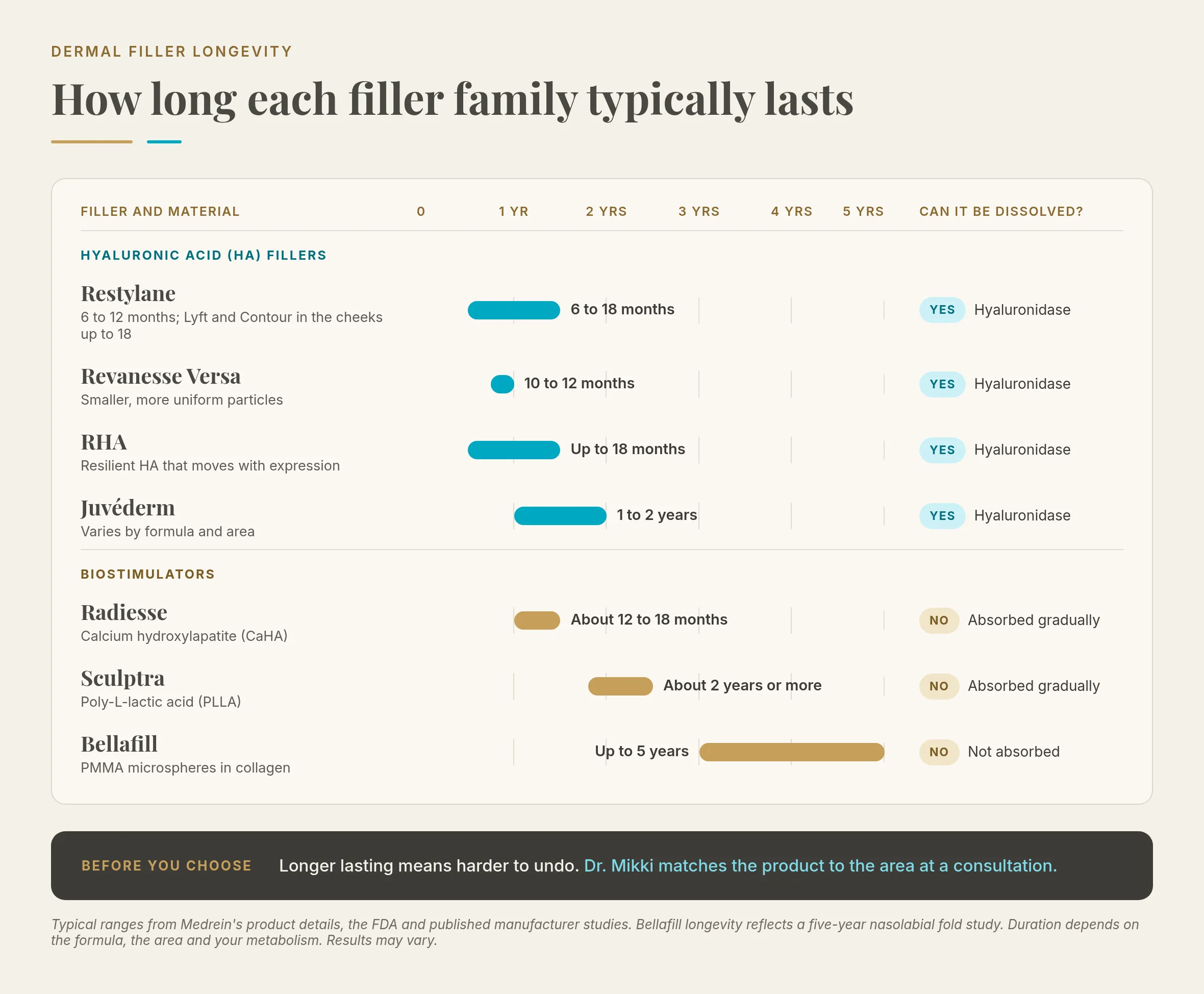
Among the HA fillers, Restylane typically holds 6 to 12 months, with Lyft and Contour in the cheeks reaching up to 18 months. Revanesse Versa lasts 10 to 12 months, RHA up to 18 months, and Juvéderm one to two years depending on the formula. Radiesse typically lasts about 12 to 18 months. Bellafill lasts the longest, and a five-year study of PMMA filler in the smile lines reported that the correction was still present at five years. Our post on Bellafill longevity goes into that product in more detail. Results may vary.
Can dermal fillers be dissolved?
HA fillers can be dissolved with an enzyme called hyaluronidase. That safety margin is one reason Dr. Mikki uses HA for most facial work. Radiesse and Sculptra are absorbed gradually but cannot be dissolved the same way. Bellafill’s microspheres are not absorbed, so it is chosen when durability matters most and the plan is settled.
Because HA and the biostimulators break down over time, most people return for touch-ups to keep a result. Dr. Mikki gives you a realistic range for your chosen filler and area at the consultation.
Getting started with dermal fillers at Medrein
At Medrein, a filler plan usually takes two appointments to finalize. Dr. Mikki keeps the amount conservative, so the result still looks like you, and more can be added later if an area needs it.
If you are weighing filler for your lips, cheeks, under-eyes or smile lines, book a consultation at our Southlake clinic. Dr. Mikki will examine your face, explain which filler suits each area and give you the full plan and cost before treatment begins.
Dermal Filler FAQs
Does dermal filler hurt?
Most people describe a pinch and a feeling of pressure. A numbing cream goes on first, and several of the fillers Medrein uses contain lidocaine, a local anesthetic, so the area keeps numbing as the gel goes in. Many patients find the lips more sensitive than the cheeks or chin. Tenderness afterward usually settles within a few days.
How long does swelling last after filler?
Mild swelling and occasional bruising usually settle within a few days to a week. The lips and under-eyes tend to swell more than the cheeks or chin. The final shape reads once the swelling has gone down, which is why Dr. Mikki judges the result after that point. Results may vary.
Can filler be dissolved?
Hyaluronic acid (HA) filler can be dissolved with an enzyme called hyaluronidase if a result needs softening or removing. Juvéderm, Restylane, RHA and Revanesse Versa are all HA fillers. Radiesse and Sculptra are absorbed gradually but cannot be dissolved this way, and Bellafill is not absorbed, so those choices call for more thought up front.
What is the difference between filler and Botox?
Dermal filler adds volume under the skin to soften folds, restore hollows and shape the lips, cheeks or chin. Botox is one brand of Neurotoxin, which temporarily relaxes the muscles that cause lines when you frown, squint or raise your brows. Many people have lines from both causes, and a plan can include each, decided at a consultation.
How many syringes of filler will I need?
It depends on the area, the formula and how much volume has been lost. Lips often need less product than cheeks or a jawline, and treating several areas takes more. Dr. Mikki tells you at your consultation which formula suits each area, how many syringes the plan uses and the total cost.
How old do you have to be to get dermal fillers?
The FDA approves dermal fillers for adults over 21, which means 22 and older. At Medrein, filler is for adults in that age group who are in good general health. Pregnancy and breastfeeding rule treatment out, and Dr. Mikki confirms candidacy at the consultation.
Sources & references
Reviewed for accuracy per our editorial policy.

About the author
Founder & Medical Director
Board-certified physician and founder of Medrein Health & Aesthetics in Southlake, and the physician who personally consults with you and performs most treatments herself.
Read full bio →Find out which filler suits your goals
Book a consultation and Dr. Mikki will explain which formula suits each area, how many syringes the plan needs and what it costs before anything is injected.
Related Articles

Long-Term Benefits of Bellafill: Why Is It the Ultimate Filler Solution?
Discover the long-term benefits of Bellafill in Southlake, TX, a collagen-based dermal filler that can last up to five years, from cost to candidacy and safety.

Is Jeuveau Better Than Botox? Southlake Guide
Jeuveau (Newtox) vs. Botox: how they compare on FDA approval, treatment areas, results timeline, and side effects for wrinkle and frown line treatment.

Jawline Filler: How Long It Lasts, Cost & FDA Approval
Jawline filler from a Southlake physician: which filler is FDA-approved for jawline definition, how long it lasts and what it costs. Book a consultation.