Wolverine Stack Peptides: BPC-157 + TB-500 Uses and Safety

Medically reviewed by:

Founder & Medical Director
Is the Wolverine Stack right for you?
Dr. Mikki screens your history and draws baseline labs before prescribing BPC-157 and TB-500.
Book a Peptide Therapy ConsultationThe Wolverine Stack is the name given to two peptides, BPC-157 and TB-500, used together to support recovery from soft-tissue and joint injuries. The nickname comes from the comic book character who heals almost instantly. The peptides themselves work more slowly, and each one supports a different part of the body’s own repair process.
Interest in the stack has grown quickly, and so has the amount of peptide sold online as a “research chemical.” Knowing what each peptide does, how the evidence stands, and who should avoid it helps you ask the right questions before you start.
What is the Wolverine Stack?
The Wolverine Stack is a pairing of two synthetic peptides, BPC-157 and TB-500, prescribed together for tissue repair. Peptides are short chains of amino acids that act as signals in the body. These two send different signals toward the same goal, which is why they are combined.
At Medrein the stack is one of several options within Peptide Therapy, and it is the simplest of the repair blends Dr. Mikki prescribes.
How BPC-157 and TB-500 work together
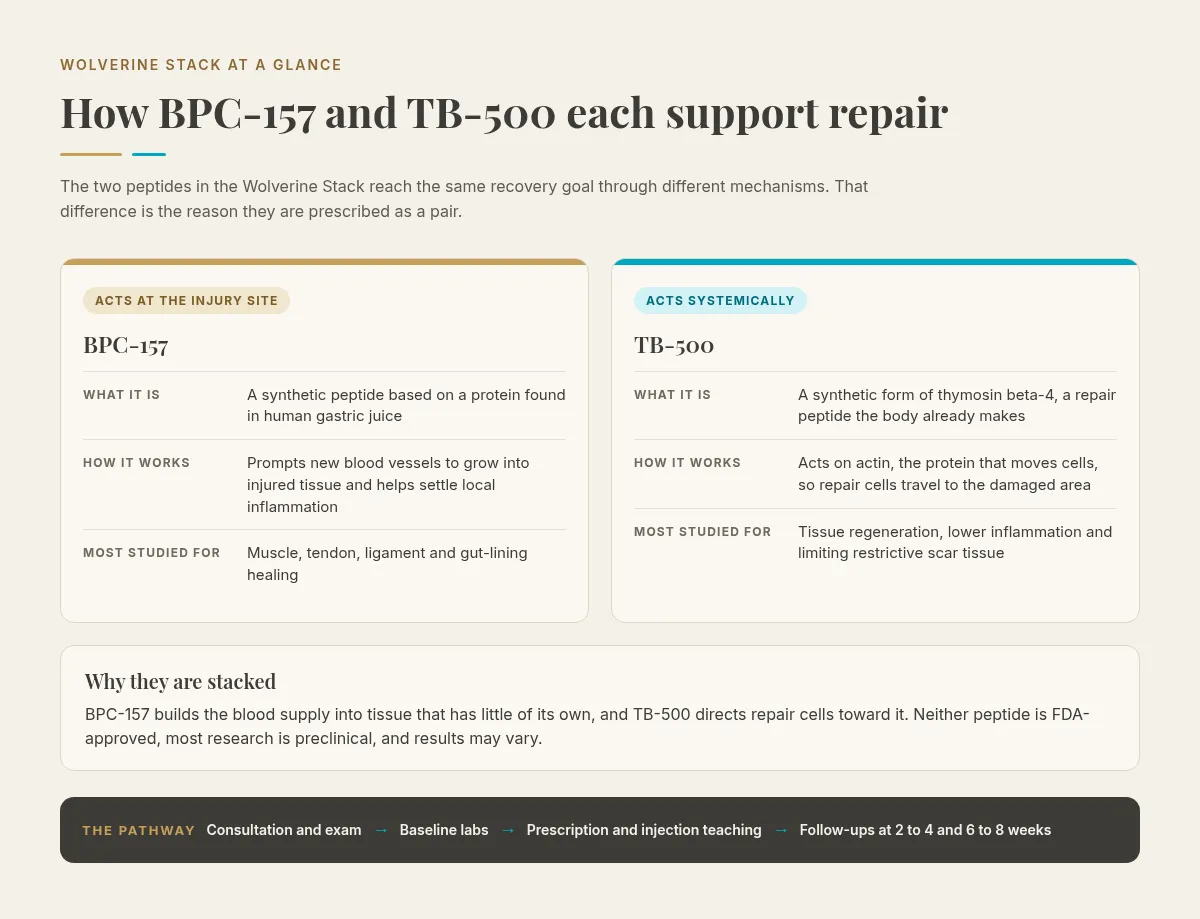
Each peptide acts on a different stage of healing. Seeing them side by side makes the reason for the pairing clear.
BPC-157
BPC-157 stands for body protection compound 157. It is a synthetic peptide based on a protein found in human gastric juice. In laboratory and animal studies it prompts new blood vessels to grow into injured tissue and helps calm the inflammation around it. That matters most in tendons and ligaments, which have a poor blood supply of their own and often heal slowly for that reason.
TB-500
TB-500 is a synthetic form of thymosin beta-4, a peptide the body already makes and uses in tissue repair. It acts on actin, the protein that lets cells move, so the cells that carry out repair can travel to the damaged area. Because it is small and moves through tissue easily, its effect is spread through the body instead of staying at one site.
Why the two are stacked
BPC-157 builds the blood supply into the injured tissue, and TB-500 helps direct repair cells toward it. Neither one does the other’s job. Dr. Mikki describes the pairing as one peptide building the road and the other directing traffic down it.
Benefits of BPC-157 and TB-500 combined
The benefits patients look for from the stack are the ones the two peptides are studied for. They include:
- Recovery from muscle strains, tendon damage and ligament sprains
- Less inflammation and discomfort around an injury
- Support for the gut lining in some digestive conditions
- Healing after surgery or a slow-closing wound
- Joint comfort and mobility for active adults
Most of this evidence comes from animal studies, so the list describes what treatment aims to support. Results may vary.
What does the research show?
The research on BPC-157 is promising but early. A 2025 systematic review in orthopaedic sports medicine found that almost all of the published work on BPC-157 is preclinical, carried out in animals or cell cultures. Human data are limited to a small number of low-level studies. The review’s authors describe the results as encouraging for tendon, ligament, muscle and bone healing, and call for controlled human trials.
TB-500 is in a similar position. Thymosin beta-4 has been studied for decades for its role in wound healing and tissue repair, but large, completed human trials of the stack are still missing. That gap is the main reason candidacy, screening and follow-up matter so much with these two peptides.
Who the stack may suit
Dr. Mikki considers the stack for adults whose injury involves soft tissue and whose goals are realistic. Typical candidates include:
- People with chronic tendon or ligament problems that have not improved with conventional care
- Athletes recovering from an acute strain, sprain or tear
- Patients healing from surgery
- Adults with persistent gut issues or inflammatory conditions
- Active people whose joint discomfort limits what they can do
If an injury needs imaging, an orthopedic opinion or physical therapy first, Dr. Mikki will say so. A diagnosis comes first, and the stack supports the repair that follows.
How is the Wolverine Stack dosed?
The Wolverine Stack is given as small subcutaneous injections, usually into the abdomen, using an insulin-type needle. Dr. Mikki’s team teaches you the technique in person so you can continue the course at home between visits.
Course length depends on the injury. Acute injuries usually call for 4 to 8 weeks, and chronic conditions often need a longer course. Dr. Mikki sets every dose and injection schedule herself after evaluating your history, and she adjusts it at follow-up based on your labs and how you are doing. Doses quoted on forums or vendor sites are not a safe starting point, because the right amount depends on the person and the injury.
The stack’s treatment page sets out the full course at Medrein step by step, from consultation and baseline labs to home injections and monitoring.
Can you take the Wolverine Stack orally?
Oral and capsule versions are sold online, mostly of BPC-157, and some animal research has looked at oral BPC-157 for the gut. At Medrein the stack is prescribed as subcutaneous injections, which is the form the course and its monitoring are built around. Products sold as capsules or “research” vials online have no prescription behind them and no documented contents, so they carry the same sourcing risks described in the safety section below.
If needles are the main concern, raise it at your consultation. The injection uses a very small needle, and most patients find the technique quick to learn once it has been shown to them in person.
How long does the Wolverine Stack take to work?
There is no reliable timeline yet, because the human research is too limited to give one. Response depends on the injury, how long you have had it, your age and your activity level.
What Medrein can tell you is how the course is monitored. Dr. Mikki sees you at two to four weeks and again at six to eight, with repeat labs around eight to twelve weeks. At each visit you decide together whether to continue, adjust the dose or stop. Results may vary.
Is the Wolverine Stack safe?
Side effects reported with BPC-157 and TB-500 are usually mild. Long-term safety in people has not been established, because most studies so far have been in animals, so screening before the first dose is essential.
Common side effects
The side effects patients report most often are:
- Redness or irritation at the injection site
- Water retention
- Tingling in the joints
Tell Dr. Mikki about any new symptom as soon as it appears, instead of waiting for the next visit.
Who should not use it
The stack is ruled out for anyone with active cancer or a history of cancer, because both peptides promote new blood vessel growth. It is also ruled out in pregnancy, with retinopathy, and for anyone under 18. Competitive athletes in drug-tested sports should avoid it as well, since USADA guidance confirms BPC-157 is prohibited in sport, and TB-500 is also on the World Anti-Doping Agency’s list.
Regulatory status and sourcing
Neither BPC-157 nor TB-500 is an FDA-approved drug, and the FDA’s position on compounding them has been under review. Ask about the current status at your consultation. At Medrein both peptides are prescription-only and are prepared by a licensed 503A compounding pharmacy. Peptides bought online as research chemicals are not made for human use and are not tested for purity, sterility or strength.
Wolverine Stack vs KLOW
KLOW is a broader blend that contains both Wolverine Stack peptides. It adds GHK-Cu, a copper peptide studied for collagen and skin quality, and KPV, a peptide studied for calming inflammation and supporting the gut lining.
The difference comes down to how many concerns you are treating. The Wolverine Stack focuses on tissue repair in tendons, ligaments, muscle and the gut. KLOW is used when skin quality or wider inflammation is part of the picture as well. Its courses usually run longer and cost more than the Wolverine Stack. Dr. Mikki recommends one or the other after your consultation, based on the injury and your goals.
Combining the stack with other therapies
Recovery often involves more than one treatment. Dr. Mikki may pair the stack with PRP and PRF treatments for hair or skin, NAD+ therapy for cellular energy, or hormone optimization when low hormones are slowing recovery. For skin healing, the stack can sit alongside microneedling with growth factors drawn from your own blood.
The stack is one of several repair peptides Medrein offers. For a closer look at the biology, the longevity angle and the lab work behind it, read Dr. Mikki’s physician’s guide to the Wolverine Stack.
Getting started with the Wolverine Stack at Medrein
The Wolverine Stack combines two peptides that support tissue repair in complementary ways. The research is still early, so it suits people who want careful screening, a monitored course and an honest answer about whether it fits.
If a tendon, ligament or joint injury is slowing you down and you want to know whether the Wolverine Stack is an option, book a consultation at Medrein’s Southlake clinic. Dr. Mikki will evaluate the injury and your history and tell you plainly whether it is right for you.
Wolverine Stack Peptides: BPC-157 and TB-500 Questions, Answered
What is the Wolverine Stack?
The Wolverine Stack is the combination of two peptides, BPC-157 and TB-500, prescribed together for soft-tissue and joint recovery. It takes its name from the comic book character known for healing quickly. BPC-157 supports blood supply and inflammation control at the injury site, while TB-500 helps repair cells move to where they are needed.
What happens at a Wolverine Stack consultation?
Dr. Mikki takes your injury and medical history, examines the area and talks through your recovery goals. Baseline labs come next, including a metabolic and hormone panel, with inflammatory markers and IGF-1 as the values she watches during the course. She then explains whether the Wolverine Stack, a broader blend such as KLOW, or another route fits your case.
Is the Wolverine Stack safe?
Large human trials have not yet established its long-term safety, so the precautions matter. At Medrein those are screening before the first dose, a prescription filled by a licensed 503A compounding pharmacy, and repeat labs during the course so anything unexpected is picked up early. Reported side effects are usually mild.
Are BPC-157 and TB-500 FDA-approved?
No. Neither peptide is an FDA-approved drug. At Medrein both are prescription-only and are prepared by a licensed 503A compounding pharmacy. Peptides sold online as research chemicals are not made for human use and are not tested for purity or sterility.
Can competitive athletes use the Wolverine Stack?
Not if you compete in a drug-tested sport. Both BPC-157 and TB-500 are on the World Anti-Doping Agency's Prohibited List, and a positive test can lead to a sanction. Recreational athletes who are not tested can talk through candidacy at a consultation.
How much does the Wolverine Stack cost?
Cost depends on how long your course runs and whether the stack is combined with other treatment. Medrein does not publish a price list for peptide therapy, and you receive a quote at your consultation before anything is prescribed.
Sources & references
Reviewed for accuracy per our editorial policy.

About the author
Founder & Medical Director
Board-certified physician and founder of Medrein Health & Aesthetics in Southlake, and the physician who personally consults with you and performs most treatments herself.
Read full bio →Is the Wolverine Stack right for you?
Book a consultation and Dr. Mikki will evaluate the injury, screen for anything that rules the stack out, and explain the course length and cost before anything starts.
Related Articles

CJC-1295 + Ipamorelin: Benefits, Dosing & Side Effects
CJC-1295 + Ipamorelin explained by a Southlake MD: FDA status, side effects, dosing schedule and a Tesamorelin vs Sermorelin chart. Book a consultation.

NAD+, MOTS-C & SS-31 Energy Peptides in Southlake
NAD+, MOTS-C, and SS-31 energy peptides in Southlake, TX: physician-supervised mitochondrial therapy for fatigue, brain fog, and declining energy levels.

Selank and Semax Peptides in Southlake, TX
Selank and Semax nootropic peptides in Southlake, TX: physician-supervised protocols for focus, memory, and anxiety reduction at Medrein.