Tesamorelin for Belly Fat: Results Timeline & Side Effects

Medically reviewed by:

Founder & Medical Director
Is Tesamorelin right for you?
Dr. Mikki evaluates your history and baseline labs, including IGF-1, before recommending a growth hormone peptide.
Book a Peptide Therapy ConsultationTesamorelin is a prescription peptide that prompts the pituitary gland to release more of the body’s own growth hormone. Most people who search for it have heard that it reduces belly fat. The research supports that for one specific kind of fat: the visceral fat packed around the abdominal organs.
Tesamorelin has a narrow FDA approval, and the changes it produces take months to show. Knowing what the label says about side effects, and who is not a candidate, lets you walk into a consultation with the right questions.
What Tesamorelin is and how it works
Tesamorelin is a synthetic version of growth hormone releasing hormone (GHRH), the signal the hypothalamus sends to tell the pituitary when to release growth hormone. It binds the same GHRH receptors, so the pituitary answers by releasing growth hormone in its normal pulses. The liver then raises its output of IGF-1, the hormone that carries much of growth hormone’s effect on fat and muscle.
Because the pituitary still makes the hormone, the body’s feedback loops stay in place. When levels climb high enough, the system slows release on its own. That is the main difference between a GHRH peptide and injecting growth hormone directly. It is also why our Tesamorelin program checks an IGF-1 level before the first dose.
The FDA-approved use
Tesamorelin is FDA-approved for one indication: reducing excess abdominal fat in adults with HIV who have lipodystrophy. It has been sold under the brand names Egrifta, Egrifta SV and Egrifta WR. The current prescribing information is also clear about what the approval leaves out. It states that the medication is not indicated for weight loss management, and that its long-term cardiovascular safety has not been established.
Off-label use for body composition
Using Tesamorelin for visceral fat outside HIV-associated lipodystrophy, or for general body composition and healthy aging, is off-label. Off-label prescribing is legal and common in medicine. It does mean the strongest evidence comes from the approved population, and the decision rests on a clinician’s judgment about your particular case. We say that plainly at consultation, and we say it here.
What the research shows for belly fat
Belly fat comes in two layers. Subcutaneous fat sits just under the skin and is the part you can pinch. Visceral fat sits deeper, around the liver and intestines, and Harvard Health describes it as the greater health concern of the two.
The trial behind Tesamorelin’s approval was published in the New England Journal of Medicine in 2007. It randomized 412 adults with HIV and excess abdominal fat to a daily 2 mg injection or a placebo for 26 weeks, then measured visceral fat on CT scans. In the NEJM trial, visceral fat fell by 15.2% in the Tesamorelin group and rose by 5.0% in the placebo group. Triglycerides and the cholesterol ratio improved as well, and IGF-1 levels rose by 81%.
Two points matter when you read those numbers. The participants were adults with HIV-associated fat gain, so results in other groups can differ. And the trial measured visceral fat, which is a different target from body weight. The useful measures on Tesamorelin are waist size, body composition and labs, and the scale can move very little while those change. Results may vary.
Is Tesamorelin similar to Ozempic?
Only in the sense that both are injected peptides. Ozempic is a brand of semaglutide, a GLP-1 receptor agonist that reduces appetite and slows stomach emptying, so people eat less and lose weight. Tesamorelin does not suppress appetite. It acts on the growth hormone axis and is studied for where fat is stored, which is a separate question from how many pounds come off.
If weight loss is your main goal, the GLP-1 and GIP medications are the ones with that evidence. Our guide to weight-loss peptides sets the two groups side by side and explains where each one fits.
Some patients have both goals at once. In that case Dr. Mikki can talk through whether Medical Weight Loss, a growth hormone peptide, or a plan that uses each at a different stage suits the pattern she sees.
Tesamorelin benefits patients report
Beyond visceral fat, patients on growth hormone peptides tend to notice better sleep before anything else. Growth hormone is released mostly during deep sleep, and many people report sleeping more soundly within the first couple of weeks. Quicker recovery after exercise and steadier energy through the day usually follow.
Over the following months the changes shift toward body composition. Patients describe a smaller waist, a little more lean muscle, and in some cases better lipid numbers on their follow-up labs. Some also mention clearer focus and firmer skin. Most of these are reported experiences and were not the endpoints of the approval trial, so they vary with age, sleep, nutrition and training. Results may vary.
How Tesamorelin is given and dosed
Tesamorelin is a small subcutaneous injection given once a day into the fatty tissue of the abdomen, as the MedlinePlus entry describes. Rotating the injection site helps limit redness and irritation. The 2007 trial used 2 mg daily, and each branded formulation carries its own labelled dose.
For off-label use, the dose and schedule are set individually and adjusted against your IGF-1 level and how you respond. A number copied from a forum or a vendor site is not a safe place to start. Many patients inject in the evening to line up with the body’s natural overnight release of growth hormone.
At Medrein, you learn the injection technique in person before you take anything home. Dr. Mikki sets the starting dose, and she is the one who changes it.
Tesamorelin side effects and who should not take it
The FDA label groups the side effects that matter most into a handful of categories. Knowing them ahead of time makes it easier to spot something early and report it.
- Injection-site reactions such as redness, itching, pain, swelling or bruising.
- Fluid retention, which can show up as joint pain, pain in the arms or legs, swelling, or carpal tunnel symptoms in the hands.
- Higher blood sugar, and in some people glucose intolerance or diabetes, which is why glucose is checked before and during treatment.
- Hypersensitivity reactions such as rash or hives, which need prompt medical attention.
- Raised IGF-1 levels, which are monitored and can be a reason to stop.
The current label carries no boxed warning. It does list four contraindications: a disrupted hypothalamic-pituitary axis (for example after pituitary surgery, a pituitary tumor, or radiation to the head), active cancer, known hypersensitivity to Tesamorelin or its ingredients, and pregnancy.
Our own not-a-fit list adds a few more. We do not prescribe Tesamorelin during breastfeeding, with uncontrolled diabetes or active proliferative retinopathy, or to anyone under 18. If your diabetes is controlled, say so at the consultation, because it calls for closer glucose monitoring. There is no downtime in the usual sense, since the injection takes seconds and most people carry on with their day.
What to expect week by week
Changes on Tesamorelin tend to arrive in a predictable order. Sleep usually improves first, with energy and recovery following within the first month. Body composition takes eight weeks or more to show.
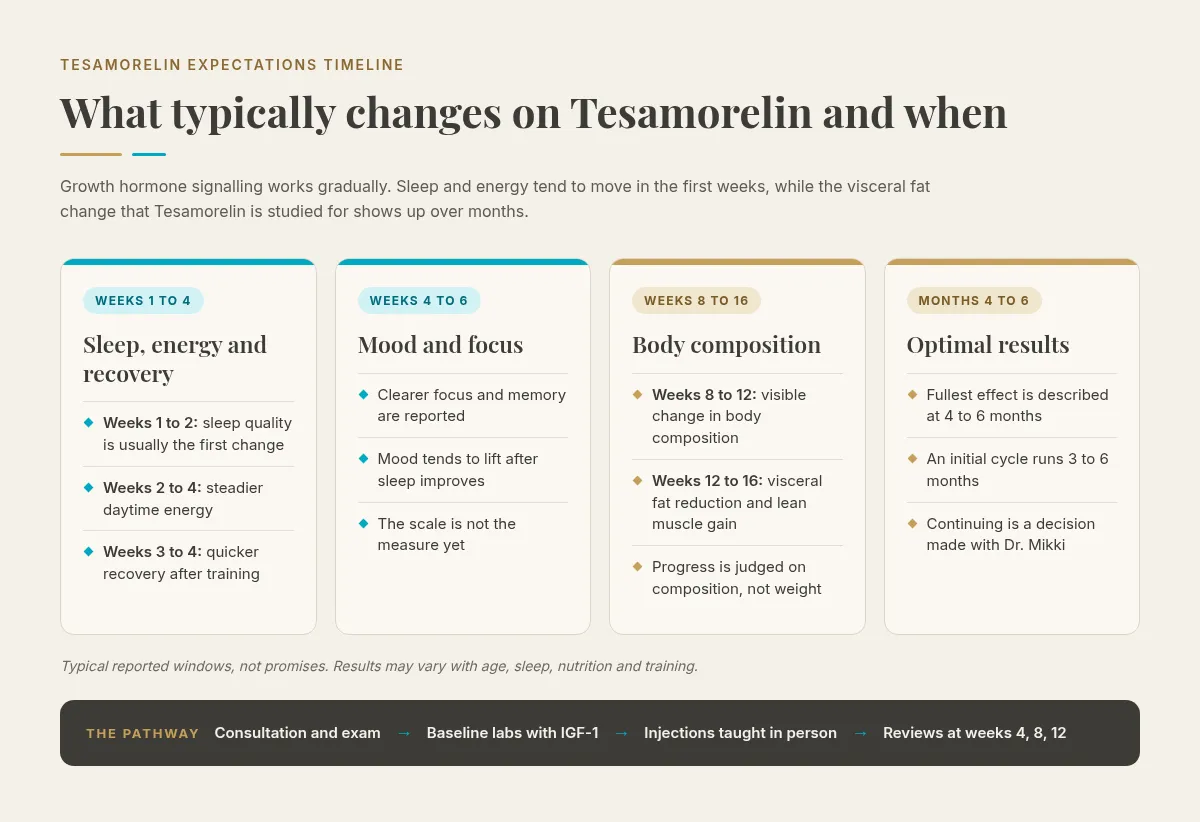
The body composition window is where the visceral fat change the trial measured tends to appear, typically from weeks 12 to 16. The fullest effect is described at four to six months, so an initial cycle runs three to six months. You may choose to continue after that, and you make that decision with Dr. Mikki based on your labs and your progress. Results may vary.
Tesamorelin and Ipamorelin together
Ipamorelin is a growth hormone secretagogue that works through a second pathway, the ghrelin receptor, instead of the GHRH receptor Tesamorelin uses. Because the two act on different receptors, pairing them reinforces the same growth hormone pulse from two directions. Ipamorelin is also selective, with little effect on cortisol or prolactin.
Ipamorelin is not FDA-approved for any use, so the combination is prescribed off-label. Medrein offers Tesamorelin with Ipamorelin as a pairing when the labs and goals support it. Dr. Mikki decides at consultation whether you need both or whether Tesamorelin on its own is enough.
Tesamorelin vs Sermorelin and CJC-1295
All three are GHRH analogs, so they share the same basic action: each one prompts your pituitary to release its own growth hormone. The differences come down to evidence, focus and how often they are dosed.
- Tesamorelin is the only one of the three sold today as an FDA-approved medication, and its research centers on visceral fat.
- Sermorelin is a shorter fragment of GHRH, given by evening injection. Our Sermorelin patients most often pursue it for sleep and recovery.
- CJC-1295 comes with or without DAC. The DAC version stays in circulation for six to eight days, while the version without DAC is dosed about daily and is usually paired with Ipamorelin.
Which one fits depends on what you want to change. When visceral fat is the target, Tesamorelin is usually where the conversation starts. When sleep and recovery lead, Sermorelin or a CJC-1295 pairing may suit you better, and our Peptide Therapy overview covers the wider range.
The consultation and lab pathway at Medrein
Candidacy for Tesamorelin is decided at a consultation. Dr. Mikki, a board-certified MD, takes a full medical history, does a physical exam and a body composition analysis, and then orders baseline labs:
- A metabolic panel and a lipid profile
- Glucose and HbA1c
- IGF-1
- Thyroid function
- A complete blood count (CBC)
Those results decide whether Tesamorelin is the right tool, whether to pair it with Ipamorelin, and where the dose starts. Once you begin, follow-up visits at four, eight and twelve weeks check how you are responding and adjust the dose. Nutrition and resistance training run alongside, because results are reported to be better when they do.
Cost depends on the plan and how long it runs. Medrein does not publish a price list, and you receive a written quote at your consultation before anything starts.
Tesamorelin is a prescription medication with an FDA approval for one specific condition, and every other use is off-label. Whether it suits you is decided at a consultation, after a history, an exam and baseline labs. Results may vary.
Getting started with Tesamorelin at Medrein
Tesamorelin is a visceral fat medication with a narrow approval and a timeline measured in months. It tends to suit people who come in with realistic expectations and keep up with their labs and follow-up visits. Regular training and good sleep help the results along.
If stubborn abdominal fat has not moved with diet and exercise and you want to know whether Tesamorelin is an option, book a consultation at our Southlake clinic. Dr. Mikki will go through your history and labs and tell you plainly whether it fits.
Tesamorelin for Belly Fat: FAQs
Is Tesamorelin FDA-approved?
Yes, for one use. Tesamorelin (sold as Egrifta SV and Egrifta WR) is FDA-approved to reduce excess abdominal fat in adults with HIV-associated lipodystrophy. Using it for visceral fat outside that condition, or for general body composition, is off-label. Ipamorelin, which is often paired with it, is not FDA-approved for any use.
Does Tesamorelin help with weight loss?
Tesamorelin is studied for visceral fat, the deep abdominal fat around the organs, and its FDA label states it is not indicated for weight loss management. Some patients see a smaller waist and better body composition while their weight changes little. If losing weight is the main goal, a GLP-1 plan may fit better, and that is decided at a consultation. Results may vary.
How long does Tesamorelin take to work?
Sleep often improves within one to two weeks and energy within two to four. Visible body composition change is reported from eight to twelve weeks, and the fullest effect at four to six months, which is why an initial cycle runs three to six months. Results may vary with age, sleep, nutrition and training.
Does the injection hurt, and is there any downtime?
The injection goes just under the skin with a small needle, and most people describe brief, mild discomfort. Redness, itching or swelling at the site can happen, and rotating sites helps. There is no downtime. Joint aches, swelling or tingling in the hands can appear, so report anything new straight away instead of waiting for your next follow-up.
How much does Tesamorelin cost at Medrein?
Cost depends on your plan and how long it runs, including whether Tesamorelin is paired with Ipamorelin. Medrein does not publish a price list. You receive a written quote at your consultation, before anything is prescribed.
What happens at a Tesamorelin consultation?
Dr. Mikki takes a full medical history, does a physical exam and a body composition analysis, and orders baseline labs: a metabolic panel, lipids, glucose and HbA1c, IGF-1, thyroid function and a CBC. Those results decide whether Tesamorelin is the right fit, and she will tell you plainly if it is not.
Is Tesamorelin right for you?
Book a consultation and Dr. Mikki will go through your history, order baseline labs and explain whether Tesamorelin fits, with a written quote before anything starts.
Related Articles

Peptides for Weight Loss: How They Work & Who They're For
How do peptides for weight loss actually work, and which ones are physician-supervised? A board-certified MD explains the real options and who is a candidate.

The Wolverine Peptide Stack: A Physician's Guide to Accelerated Recovery and Cellular Repair
Frustrated with slow recovery? A physician explains the wolverine peptide stack for safe, accelerated healing and cellular repair. Learn how it works.

Peptide Therapy vs Traditional Anti-Aging: Which Delivers Real Results in Southlake
Compare how peptide therapy works versus traditional anti-aging treatments in Southlake. Dr. Mikki explains protocols, timelines, and physician-supervised care.