Jawline Filler: How Long It Lasts, Cost & FDA Approval

Medically reviewed by:

Founder & Medical Director
Is jawline filler right for you?
Dr. Mikki examines your jaw and profile and explains whether hyaluronic acid filler or a biostimulator fits the structure you want.
Book an Injectables ConsultationJawline filler is an injectable gel placed along the jaw to sharpen its edge and restore structure where the bone or the tissue over it has flattened. As the lower face loses definition, the line from ear to chin can look softer or less distinct, especially from the side.
Before booking, most people want to know which product is actually approved for the jawline, how long a result holds and what it costs. This guide answers all three, then covers what happens at the appointment and the risks worth knowing first.
What jawline filler is and what it can do
Most jawline filler is hyaluronic acid (HA), a sugar your skin already makes. Placed along the jawbone, the gel adds structure and can sharpen the line from the ear to the chin. All of the Dermal Fillers Medrein uses are FDA-approved hyaluronic acid gels from four families: Juvéderm, Restylane, RHA and Revanesse Versa. Each family includes gels of different thickness, and Dr. Mikki selects the specific product and placement for your jaw at your consultation.
A sharper jaw also changes how the rest of the face reads in profile. Some patients need jaw support only, and others benefit from pairing it with cheek filler above it or under-eye filler if midface volume loss is part of the picture.
What jawline filler cannot do
Filler adds structure where volume is missing, and it has no tightening effect on skin that has become lax along the jaw and neck, sometimes called jowls. Adding filler to try to correct true laxity tends to make the area look heavy. When loose skin and early jowling are the main concern, a laser-fiber treatment such as EndoTight tightens the skin and the tissue underneath it, which filler cannot do on its own.
Which filler is FDA-approved for jawline definition
The FDA approves dermal fillers for specific areas of the face, and the general approved-use list for the category covers augmentation of the lips, cheeks, chin and back of the hand, among other uses, according to the agency’s page on dermal filler safety. Jawline definition itself is a narrower, newer category.
One hyaluronic acid filler carries an approval written specifically for the jawline. The FDA approved Juvéderm Volux XC in 2022 for the correction of jawline definition in adults over 21 with moderate to severe loss of jawline definition, as its FDA approval record describes. Patients in the clinical study needed multiple injections for the best outcome, and results lasted up to 12 months.
Medrein’s current Juvéderm lineup, Juvéderm XC, Vollure XC, Volbella XC and Voluma XC, does not include Volux XC. The two hyaluronic acid formulas actually placed along the jawline here are RHA 4 and Revanesse Versa. Both carry an FDA approval for moderate to severe facial wrinkles and folds. Neither approval is written specifically for the jawline, and Dr. Mikki places them along the jaw based on your anatomy, a common and well-established use of these products. A related option worth knowing about: Restylane Defyne, part of the same Restylane family Medrein carries, has its own FDA approval for the chin region specifically, described in its approval record as improving chin profile appearance in adults over 21, separate from jawline work.
Hyaluronic acid filler vs Radiesse and Sculptra for the jawline
Hyaluronic acid is one way to add structure along the jaw. Another is a collagen stimulator, known as a biostimulator, which prompts your own skin to lay down new collagen over the following weeks. Medrein’s Biostimulators service includes Radiesse and Sculptra, both used for jaw and chin contouring, along with Bellafill.
The two approaches differ most in how quickly the structure shows and whether the result can be reversed.
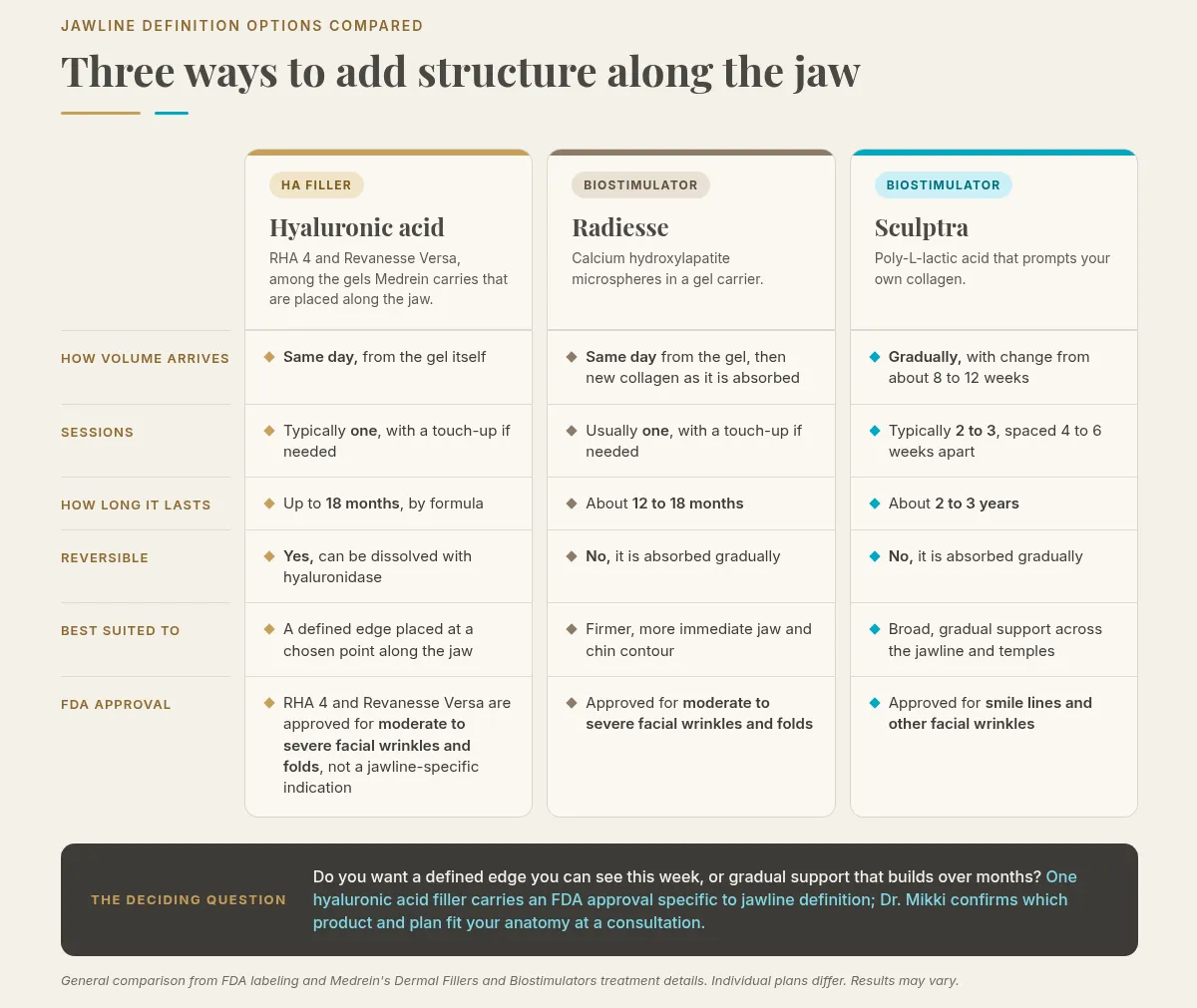
Hyaluronic acid filler suits a patient who wants a visible edge the same week and likes knowing it can be adjusted. Radiesse is firmer and gives definition on the day, then builds collagen as its gel carrier is absorbed, which suits a more immediate jaw and chin contour. Sculptra suits broader, gradual support across the jawline and temples, and it usually takes two to three sessions spaced four to six weeks apart before the full change settles in.
Neither Radiesse nor Sculptra carries an approval written for the jawline. Radiesse is approved for moderate to severe facial wrinkles and folds and for volume loss in the back of the hands. Sculptra is approved for smile lines and other facial wrinkles. Dr. Mikki uses both for jaw and chin contouring as an established practice built on how the material behaves, confirmed against your anatomy at consultation.
How long does jawline filler last
Longevity depends on the product, how much structure your jaw needed and how quickly your body breaks the material down. Among the hyaluronic acid formulas placed along the jaw here, RHA holds up to 18 months and Revanesse Versa lasts about 10 to 12 months. Juvéderm Volux XC, the FDA-approved jawline-specific option, held results up to 12 months in its own clinical study.
Among the biostimulators, Radiesse lasts about 12 to 18 months, and Sculptra results last about two to three years as new collagen continues to build. Hyaluronic acid fades gradually, so the jawline softens back toward its starting point over time, and a touch-up can be planned as the result fades. Metabolism and how much the area moves both play a part, which is why Dr. Mikki gives you a realistic range for your own face. Results may vary.
How many syringes does the jawline need
There is no standard number. The amount depends on how much definition is missing, your bone structure and jaw angle, and whether the jawline is treated alone or alongside the chin or cheeks. A patient who wants a slightly cleaner edge needs far less product than a patient correcting significant recession along the jaw.
Dr. Mikki prefers to place conservatively and assess the balance of the whole lower face before adding more. She will tell you plainly if your jawline is already proportionate and does not need filler. The syringe count for your face is set at the consultation.
How much does jawline filler cost
Filler is usually priced by the syringe, and the price differs between products. The total therefore depends on the formula Dr. Mikki recommends and how many syringes your jaw needs. Medrein does not publish a per-treatment price list, and you receive a quote at your consultation before anything is injected.
Patients who come in regularly can lower the cost through a membership. The Beauty Club and Glow Club both include $50 off fillers, and the Laser Club includes 10% off fillers. Before you book, our dermal filler basics guide covers the questions most first-time patients ask.
What happens at a jawline filler appointment
The first step is a consultation. Dr. Mikki examines your jaw, chin and facial proportions, asks about your medical history and medications, and explains what filler can and cannot do for the concern you came in with. Expect two appointments to finalize a plan.
On treatment day, the area is cleansed and a numbing cream is applied. Several of the jawline gels also contain lidocaine, so the area keeps numbing as the filler goes in. Dr. Mikki places the gel along the chosen points, then gently massages the area so it sits evenly under the skin. The injection itself takes around 30 minutes, and an appointment runs anywhere from 15 minutes to an hour, depending on how many areas are treated.
Most patients return to normal activities the same day. For the first six hours, avoid touching the treated area. For the first 24 hours, stay away from intense heat and direct sun, and skip strenuous exercise and alcohol. Our aftercare guide covers the first 72 hours in more detail.
Jawline filler before and after
With hyaluronic acid filler, you see the new edge as soon as the gel is placed. Mild swelling in the first few days can make the jaw look fuller or less sharp than the final result. Once swelling and any bruising settle, usually within a few days to a week, the true line shows. Radiesse follows a similar pattern on the day and then firms gradually as new collagen forms. Sculptra shows little at first and builds from about 8 to 12 weeks.
Photos from real patients are the best way to judge what a natural result looks like. Our patient gallery includes dermal filler results from the Juvéderm, Restylane and Revanesse families. Every jaw starts from a different point, so another patient’s result is only a rough guide to your own. Results may vary.
Who is a good candidate for jawline filler
Good candidates are in good general health and over 21, with a jaw or chin that has genuinely lost definition or never had much to begin with. Revanesse Versa is indicated from age 22. Filler is postponed or avoided if any of these apply:
- You are pregnant or breastfeeding.
- An active skin condition sits in the area, such as acne, rosacea or psoriasis.
- You have a known allergy to hyaluronic acid, lidocaine or streptococcal proteins.
- You have a bleeding or clotting disorder or take a blood thinner.
- You have a history of hypertrophic or keloid scarring.
- You are within four weeks of a laser treatment, a Chemical Peel or dermabrasion.
Jawline filler for men
Men often ask for jawline filler to build a stronger, more angular line from ear to chin, and the product and approach are the same as for any other patient: HA filler or a biostimulator placed along the jaw at points Dr. Mikki maps to your bone structure. Some men want the opposite change. A jaw that reads wide or square sometimes comes from an overactive masseter, the muscle used for chewing. That is a different cause than missing structure, and it calls for a different tool: softening that muscle with a Neurotoxin can narrow the lower face. Dr. Mikki examines your jaw and the muscle beneath it to confirm which approach, or combination, fits what you want.
Jawline filler side effects and risks
The most common side effects are temporary and appear at the injection sites. They include swelling, bruising, redness, tenderness and small bumps, and most settle within a few days to a week. Lumps or unevenness can form and can be corrected. Infection is rare.
The most serious risk is filler entering a blood vessel by accident. This is uncommon, but it can block blood flow and lead to tissue damage, vision problems or stroke. It is treated as an emergency. Hyaluronic acid can be dissolved with hyaluronidase, which is one reason it is the mainstay for facial work. Radiesse and Sculptra cannot be dissolved in the same way.
Choosing an injector who knows facial anatomy in detail lowers these risks. The American Academy of Dermatology’s filler FAQs note that serious side effects are more likely when the injector lacks adequate medical training and experience. Seek care straight away if you notice unusual pain, skin that turns white or dusky, or any change in vision. Our guide to warning signs lists what to watch for after any injectable.
Juvéderm Volux XC is the only hyaluronic acid filler with an FDA approval specific to jawline definition. Medrein’s current fillers, including RHA 4 and Revanesse Versa, are approved for facial wrinkles and folds and placed along the jaw based on your anatomy. Whether filler or a biostimulator suits you is decided at a consultation. Results may vary.
Getting started with jawline filler at Medrein
Jawline filler works best as a measured correction, adding structure only where it is genuinely missing. Choosing between hyaluronic acid filler and a biostimulator comes down to your anatomy and how soon you want to see the change.
If your jawline has started to look softer than you would like and you want to know what would help, book a consultation at our Southlake clinic. Dr. Mikki will examine your jaw and profile and walk you through your options before anything is booked.
Jawline Filler FAQs
Is jawline filler reversible?
Yes, hyaluronic acid jawline filler is reversible. An enzyme called hyaluronidase breaks the gel down, so a result that needs softening can be adjusted. Radiesse and Sculptra cannot be dissolved, and the body absorbs them gradually, which is why Dr. Mikki explains that difference before you choose a product.
Does jawline filler hurt?
Most patients describe pressure and brief stinging along the jaw. A numbing cream goes on first, and several of the gels used here contain lidocaine, which numbs the area further as the filler is placed. Tenderness can last a few days afterward.
How soon will I see results from jawline filler?
Hyaluronic acid filler shows a change the same day. Mild swelling in the first few days can make the jaw look fuller than the final result, and the true edge reads once that settles, usually within a week. Sculptra works differently and builds from about 8 to 12 weeks. Results may vary.
Can jawline filler make my face look wider instead of more defined?
Not when it's placed well. Filler sharpens the edge of the jaw without adding bulk to the sides of the face, though too much product, or product placed in the wrong plane, can read as heavy. Dr. Mikki plans conservatively and will tell you plainly if your jawline does not need filler at all.
How much does jawline filler cost at Medrein?
Cost depends on the product and how many syringes your plan needs. Medrein does not publish per-treatment prices, so you receive a quote at your consultation before anything is injected. Beauty Club and Glow Club members receive $50 off fillers.
Can jawline filler be combined with chin filler?
Often, yes. A soft jawline and a less projected chin frequently show up together, and Dr. Mikki may recommend treating both in one plan. Restylane Defyne, part of the Restylane family carried here, has its own FDA approval for improving the chin profile, separate from jawline work.
Who should not get jawline filler?
Filler is postponed during pregnancy or breastfeeding and when an active skin condition or infection sits in the area. It is also avoided with a known allergy to hyaluronic acid or lidocaine, a bleeding disorder, or a history of keloid scarring. Dr. Mikki goes through your medical history and medications at the consultation.
Wondering what your jawline actually needs?
Book a consultation and Dr. Mikki will assess your jaw and profile, explain your options and give you a quote before anything is injected.
Related Articles

Preventative Botox: What Age to Start and Does It Work
Preventative Botox explained by a Southlake, TX physician: a dynamic-vs-static-lines chart, the real answer on age, and honest cost. Book a consultation.

Cheek Filler: How Long It Lasts, Cost & Sculptra vs HA
Cheek filler from a Southlake MD: which fillers are FDA-approved for cheeks, how long each lasts, plus a hyaluronic acid vs Sculptra chart. Book a consultation.

Under Eye Filler: Candidacy Chart, Recovery and Side Effects
Under eye filler by a Southlake MD: a chart of which under-eye concerns filler suits, FDA-approved options, side effects and recovery. Book a consultation.