Peptides for Muscle Growth: Evidence, Safety & FDA Status

Medically reviewed by:

Founder & Medical Director
Wondering if a peptide fits your training?
Dr. Mikki checks your history and baseline labs, including IGF-1 and testosterone, before recommending anything.
Book a Peptide Therapy ConsultationPeptides for muscle growth are short chains of amino acids that are marketed as a way to add muscle faster. Most of them either prompt the body to release more of its own growth hormone or help injured tissue repair. The ads rarely mention that none of them is approved by the FDA for building muscle.
The evidence is thinner than social media suggests, and the regulatory picture matters, especially if you compete in a tested sport. This guide separates what these peptides do from what they are sold to do, so you can ask sharper questions at a consultation.
What people mean by peptides for muscle growth
A peptide is a short chain of amino acids that acts as a signal in the body. Insulin is a peptide, and so are many of the hormones that control appetite and growth. When people search for peptides for muscle, they usually mean one of two groups.
The first group is growth hormone secretagogues. These prompt the pituitary gland to release more of your own growth hormone, which then raises IGF-1, the hormone that carries much of growth hormone’s effect on muscle and fat. Our page on GHRH peptides explains that category in more detail.
The second group is recovery peptides, mainly BPC-157 and TB-500. These are studied for repair of tendon, ligament and muscle tissue after injury. Their role is recovery, and any effect on muscle size is indirect.
Neither group is an anabolic steroid. Steroids are testosterone-like drugs that act directly on muscle cells. Peptides act further upstream or on repair, and their effects on muscle are smaller and far less studied.
How growth hormone peptides work
Growth hormone is released in pulses, mostly during deep sleep. Growth hormone secretagogues strengthen those pulses in one of two ways. Some copy growth hormone releasing hormone (GHRH), the signal the hypothalamus sends to the pituitary. Others act on the ghrelin receptor, a second route to the same release. Because your own pituitary still makes the hormone, the body’s feedback loops stay in place.
CJC-1295 and Ipamorelin
CJC-1295 is a GHRH analog. It comes in two forms. The version with DAC stays in circulation for six to eight days, while the version without DAC clears quickly and is usually given daily. Ipamorelin works through the ghrelin receptor and has little effect on cortisol or prolactin. Pairing the two reinforces the same growth hormone pulse from two directions, which is why our CJC-1295 pairing is the combination patients ask about most.
Neither CJC-1295 nor Ipamorelin is FDA-approved for any use. At Medrein they are prescribed off-label and compounded to order by a licensed pharmacy.
Sermorelin
Sermorelin is a shorter fragment of GHRH, given by evening injection to line up with the body’s overnight growth hormone release. A branded version called Geref was once FDA-approved, and its manufacturer stopped selling it in 2008. The FDA later published a Federal Register determination that it was not withdrawn for reasons of safety or effectiveness. No FDA-approved Sermorelin product is marketed today, so current use relies on compounding pharmacies. Patients in our Sermorelin program most often pursue it for sleep and recovery.
Tesamorelin
Tesamorelin is the only one of the three sold as an FDA-approved medication, under the Egrifta brand names. Its prescribing information limits that approval to reducing excess abdominal fat in adults with HIV-associated lipodystrophy. Using it for muscle or general body composition is off-label. Our Tesamorelin guide covers the label, the trial data and a realistic timeline.
What the research shows for muscle
There are very few human trials of these peptides with muscle growth in healthy adults as the endpoint. Most of what is known comes from studies of growth hormone itself, which the peptides raise indirectly.
A systematic review in the Annals of Internal Medicine pooled trials of growth hormone in fit, healthy adults with an average age of 27. The 2008 review found that lean body mass rose by about 2.1 kg on average, while strength and exercise capacity did not improve. Participants on growth hormone also had more fluid retention and fatigue.
That result matters for anyone reading peptide ads. Lean body mass on a scan includes water held in tissue, so a higher number does not always mean stronger muscle. If direct growth hormone did not improve strength in those trials, a peptide that raises growth hormone more gently should not be expected to do more.
Where patients do report changes, they tend to come in a familiar order. Sleep often improves in the first one to two weeks and energy by weeks two to four. Changes in muscle definition and body composition, when they appear, are usually described at eight to twelve weeks, alongside training and nutrition. Results may vary with age, sleep, diet and how consistently you train.
Recovery peptides and muscle repair
BPC-157 is a synthetic peptide based on a protein found in gastric juice. It is studied for new blood vessel growth into injured tendon, ligament and muscle. TB-500 is a synthetic fragment of thymosin beta-4, a peptide the body already uses to move repair cells to damaged tissue. Most of the research on both comes from animal and laboratory studies, and large human trials are still ongoing.
Neither peptide is FDA-approved. The FDA’s page on compounding safety risks lists BPC-157, TB-500 and CJC-1295 with its concerns, including possible immune reactions and impurities, and notes that it has little or no human safety data for BPC-157. That page is worth reading before you buy anything labelled for research use.
For someone who trains hard, the realistic role for these peptides is recovery from an injury or a nagging soft-tissue problem. Our Wolverine Stack page explains how Dr. Mikki uses the pairing and who is not a candidate. Results may vary.
What actually builds muscle
Muscle grows when resistance training creates a demand and the body has the protein, sleep and hormones to answer it. Each of those carries far stronger evidence than any peptide.
Progressive resistance training is the stimulus. Protein supplies the raw material. A meta-analysis of 49 trials with 1,863 participants found that extra protein added to resistance training increased strength and muscle size. In that protein meta-analysis, gains in lean mass stopped rising once total intake passed about 1.6 g of protein per kg of body weight a day.
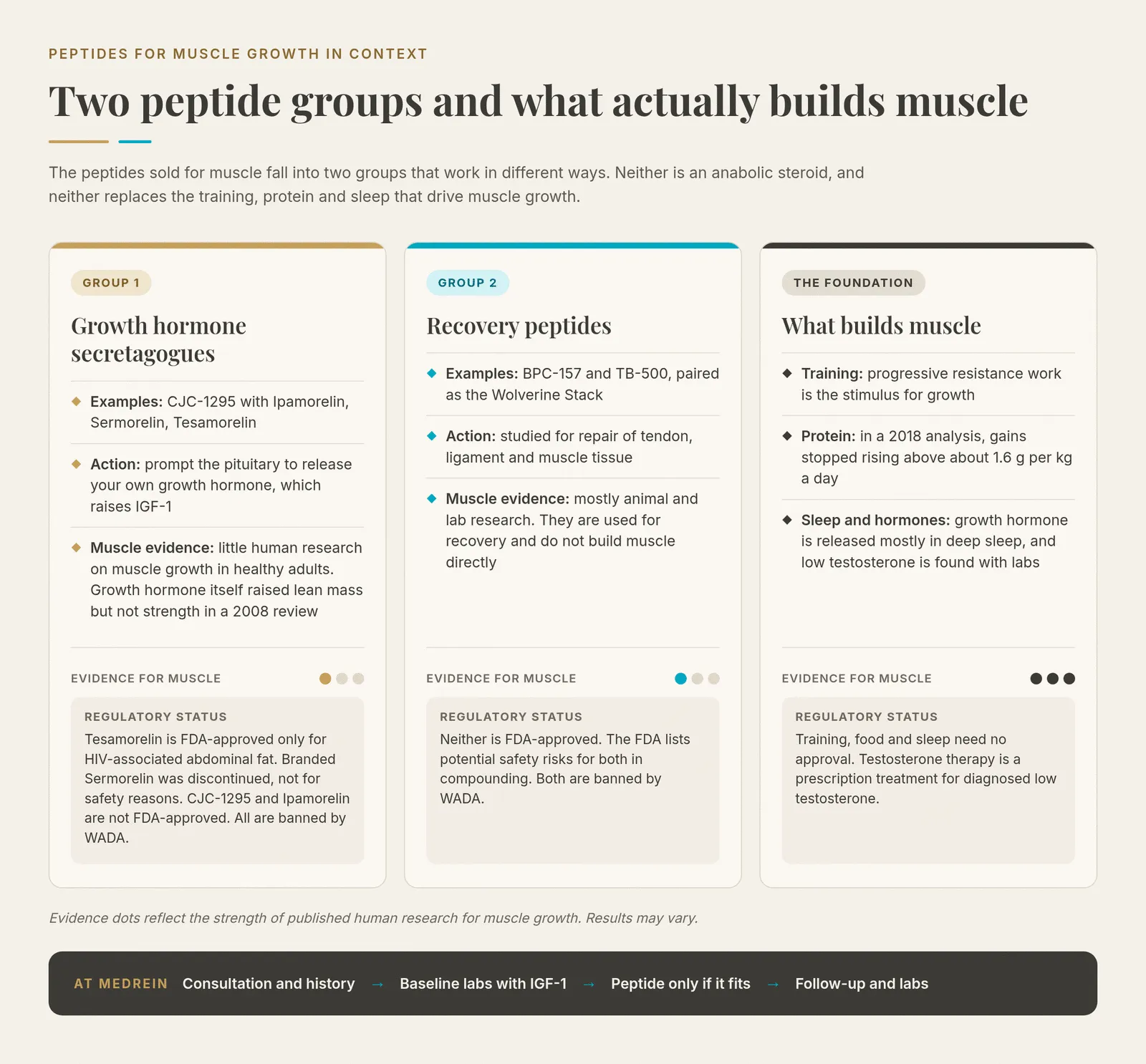
Sleep matters because most growth hormone is released during deep sleep, and short sleep undercuts both recovery and training quality. Hormones matter too. Low testosterone in men can make muscle hard to build and keep, and it is found with a blood test. When labs confirm it, testosterone therapy is a prescription treatment with a much longer research record than any peptide.
Are peptides safer than steroids?
They carry different risks, and neither is free of them. Anabolic steroids are synthetic variations of testosterone. NIDA’s steroid overview links misuse to high blood pressure, heart attack and stroke, liver tumors, shrinking testicles in men and aggression. Selective androgen receptor modulators (SARMs), often sold as a middle ground, are not FDA-approved for any use.
Growth hormone peptides work through your own pituitary, which slows its own release when levels climb. That is why they are generally described as milder. It does not make them proven safe. Long-term data in healthy adults is limited, and products bought online have unknown purity.
Side effects and who should not use them
The side effects reported with growth hormone and recovery peptides are usually mild and tend to track the dose. Knowing them in advance makes it easier to report something early.
- Injection-site reactions such as redness, itching or irritation.
- Temporary water retention and mild joint aches.
- Increased hunger, which comes from the Ipamorelin side of that pairing.
- Flushing or a mild headache, reported with Sermorelin.
- Higher blood sugar, which is why glucose is part of the baseline labs.
Some people should not use these peptides at all. Our not-a-fit list includes active cancer or a recent history of it, pregnancy or breastfeeding, anyone under 18, active diabetic retinopathy, certain pituitary tumors and acute critical illness. BPC-157 and TB-500 are not prescribed to anyone with a history of cancer, because they promote new blood vessel growth.
Gray-market products carry a separate risk. Harvard Health notes that many injectable peptides sold online are labelled for research only and may contain contaminants. At Medrein, every peptide is compounded by a licensed pharmacy on Dr. Mikki’s prescription.
Peptides and drug-tested athletes
If you compete in a sport that tests, these peptides are off the table. The WADA Prohibited List bans growth hormone releasing factors, including CJC-1295, Sermorelin and Tesamorelin, and growth hormone secretagogues such as Ipamorelin. It also bans TB-500 as a thymosin beta-4 derivative and BPC-157 as a non-approved substance. All of them are prohibited at all times, in and out of competition.
Most Olympic, professional and college sports test against this list or one based on it. Tell us at the consultation if you are tested, and Dr. Mikki will plan around it.
Protecting muscle during weight loss
Many people ask about muscle peptides because they are losing weight on a GLP-1 medication and want to keep their muscle. Some lean mass loss is common during rapid weight loss, and resistance training with enough protein is the first defense.
In some cases a growth hormone peptide may be added as a supporting option. That is a decision for Dr. Mikki after she sees your labs, and it should never be stacked on your own. Our guide to weight-loss peptides explains how the two peptide groups fit together, and our Medical Weight Loss program covers the nutrition and follow-up side. Results may vary.
How Medrein approaches a muscle goal
A muscle goal starts with a consultation with Dr. Mikki, a board-certified MD. She takes a full history, asks how you train and sleep, and orders baseline labs before anything is prescribed:
- Metabolic and blood sugar markers
- A lipid panel and a blood count
- Thyroid function
- Testosterone
- IGF-1, the growth hormone marker later results are read against
Those results often point somewhere other than a peptide. Low testosterone, poor sleep or too little protein are common findings, and each has its own fix. If a peptide does fit, Dr. Mikki chooses which one and sets the dose. You learn the injection technique in person, and follow-up visits start within the first month, with labs repeated to check your response.
Cost depends on what fits and how long the course runs. Medrein does not publish a price list, and you receive a quote at your consultation before anything starts.
No peptide is FDA-approved for muscle growth, and all of them are banned for tested athletes. Whether one belongs in your plan is decided at a consultation, after a history and baseline labs. Results may vary.
Getting started with Peptide Therapy at Medrein
Peptides for muscle growth are an adjunct at best. In the right patient a growth hormone peptide may support recovery, and a recovery peptide may help an injury heal. The muscle itself still comes from the work you do in the gym and the kitchen.
If your progress has stalled and you want an honest answer about whether a peptide could help, book a consultation at our Southlake clinic. Dr. Mikki will go through your history and labs and tell you plainly whether it fits.
Peptides for Muscle Growth: Your Questions Answered
Do peptides actually build muscle?
Not on their own. Growth hormone peptides raise your own growth hormone and IGF-1, and a 2008 review found that growth hormone itself raised lean mass in healthy adults while strength did not improve. Recovery peptides are studied for repair. Training and protein drive muscle growth, and a peptide can only support that work. Results may vary.
Which peptides are best for muscle growth?
No peptide has FDA approval for muscle growth, so there is no evidence-based best. CJC-1295 with Ipamorelin, Sermorelin and Tesamorelin are the growth hormone options people ask about most, and BPC-157 with TB-500 is used for recovery. Which one fits, if any, depends on your goals, history and labs, and that is decided at a consultation.
Are peptides safer than steroids?
They carry different risks. Anabolic steroids are synthetic versions of testosterone with well-documented harms to the heart and liver. Growth hormone peptides work through your own pituitary and are generally described as milder, but their long-term safety in healthy adults has not been established. Neither should be sourced online or used without labs and follow-up.
What are the side effects of muscle growth peptides?
The common ones are redness or irritation at the injection site, temporary water retention, mild joint aches and, with Ipamorelin, more hunger. Sermorelin can cause flushing or a mild headache. Growth hormone peptides can raise blood sugar, which is one reason labs come first. Tell Dr. Mikki about anything new instead of waiting for your next visit.
Can I use peptides if I compete in a tested sport?
No. The World Anti-Doping Agency prohibits growth hormone releasing peptides, growth hormone secretagogues, BPC-157 and TB-500 at all times, in and out of competition. If you are subject to drug testing, tell us at your consultation so the plan stays within your sport's rules.
How much does peptide therapy for muscle cost at Medrein?
Cost depends on which peptide, if any, fits your case and how long the course runs. Medrein does not publish a price list. You receive a quote at your consultation, after your history and baseline labs and before anything is prescribed.
Wondering if a peptide fits your training?
Book a consultation and Dr. Mikki will go through your goals, your training and your labs, then tell you plainly whether a peptide has a place in your plan.
Related Articles

Tesamorelin for Belly Fat: Results Timeline & Side Effects
Tesamorelin explained by a Southlake MD: what the FDA label says, side effects, who qualifies, and a week-by-week results timeline chart. Book a consultation.

Peptides for Weight Loss: How They Work & Who They're For
How do peptides for weight loss actually work, and which ones are physician-supervised? A board-certified MD explains the real options and who is a candidate.

The Wolverine Peptide Stack: A Physician's Guide to Accelerated Recovery and Cellular Repair
Frustrated with slow recovery? A physician explains the wolverine peptide stack for safe, accelerated healing and cellular repair. Learn how it works.