GHK-Cu: Topical vs Injectable Evidence, Risks & FDA Status
Medically reviewed by:

Founder & Medical Director
Is GHK-Cu right for your skin or hair?
Dr. Mikki evaluates your goals and history, explains each route and its FDA status, and tells you plainly whether GHK-Cu fits.
Book a Peptide Therapy ConsultationGHK-Cu is a small copper peptide that the body makes on its own, and it has become one of the most searched ingredients in skin care. You will find it in serums on store shelves, in scalp products and, more recently, in vials sold for injection.
The research behind it is real, but most of it is small or comes from the lab. Knowing what the studies measured, and how the FDA treats topical and injectable forms, helps you judge the claims before you spend money on any of them.
What GHK-Cu is
GHK-Cu is a tripeptide, a chain of three amino acids (glycine, histidine and lysine), bound to a copper ion. It occurs naturally in human plasma, saliva and urine. On ingredient labels it often appears as copper tripeptide-1. Our GHK-Cu program uses the same molecule, prescribed and compounded to a known concentration.
The peptide was first isolated in 1973 by the chemist Loren Pickart, who noticed that plasma from younger adults prompted older liver tissue to behave more like young tissue. Levels fall with age. Plasma GHK sits at about 200 ng/mL at age 20 and drops to about 80 ng/mL by age 60, a decline that researchers link to slower tissue repair.
How the copper peptide works
GHK-Cu acts as a signaling molecule. In laboratory studies it prompts fibroblasts, the cells that build the skin’s support structure, to produce more collagen, elastin and glycosaminoglycans such as hyaluronic acid. It also stimulates the enzymes that break down damaged collagen, so it is described as a remodeling signal that clears old tissue while new fibers form.
It is also studied for antioxidant and anti-inflammatory effects and for its role in carrying copper, a mineral that several repair enzymes need. Analyses of gene data suggest GHK can influence the activity of around 4,000 human genes. That figure comes from computer and cell studies, so it describes how broadly the peptide may act in the lab. What a serum does on your face is a separate and much smaller question.
What the research shows by area
The honest summary is that GHK-Cu has decades of laboratory research and a small number of human studies, most of them on topical products. A 2018 research review in the International Journal of Molecular Sciences collects much of that work, and its authors are researchers at a skin care company, which is worth keeping in mind as you read the findings.
Skin quality
This is where the human evidence is strongest. In one study, 71 women with mild to advanced sun damage applied a facial cream containing GHK-Cu for 12 weeks. Their skin became denser and thicker, with less laxity and shallower wrinkles. In another, 41 women used a GHK-Cu eye cream for 12 weeks, and it outperformed both a placebo and a vitamin K cream on lines and skin density.
These studies are small, short and often funded by the cosmetic industry. They support the idea that topical GHK-Cu may help with firmness, fine lines and tone over a few months. They do not show that it matches in-office treatments. Results may vary.
Hair and the scalp
GHK-Cu is studied for follicle support. Laboratory and animal work suggests it may improve blood flow to the follicle, encourage growth factors and extend the growth phase of the hair cycle. Well-designed human trials for hair loss are limited, so it is best seen as a supporting ingredient.
Thinning hair has many causes, from genetics to hormones and thyroid problems. The American Academy of Dermatology stresses that finding the cause comes before choosing a treatment. That is why GHK-Cu usually sits inside a wider Hair Restoration plan at Medrein, and our overview of regenerative hair options explains how the pieces fit together.
Wound healing and recovery
GHK-Cu first drew attention for wound repair. In rabbits and rats it sped up healing, increased new blood vessel growth and raised antioxidant enzyme levels, including in diabetic wounds. Human data on recovery are much thinner, and most of the systemic claims you see online come from these animal studies.
At Medrein, GHK-Cu is also offered as part of the Glow Complex, which adds it to TB-500 and BPC-157 so skin quality and recovery are addressed in the same plan. Our repair peptides page covers that group.
GHK-Cu vs retinol
Retinol and prescription tretinoin are retinoids, and they have decades of clinical research behind them for fine lines and sun damage. GHK-Cu has far less. The one head-to-head comparison most often quoted is a 12-week study on thigh skin. Collagen production improved in 70% of the women using GHK-Cu, 50% of those using a vitamin C cream and 40% of those using retinoic acid.
That result is interesting, but it came from a small study on thigh skin that measured collagen production. It is a long way from proof that GHK-Cu outperforms a retinoid on the face. The two work through different routes, and GHK-Cu tends to cause less irritation, so some people use both. Whether that suits your skin, and in what order, is worth settling at a consultation. Results may vary.
Topical vs injectable GHK-Cu
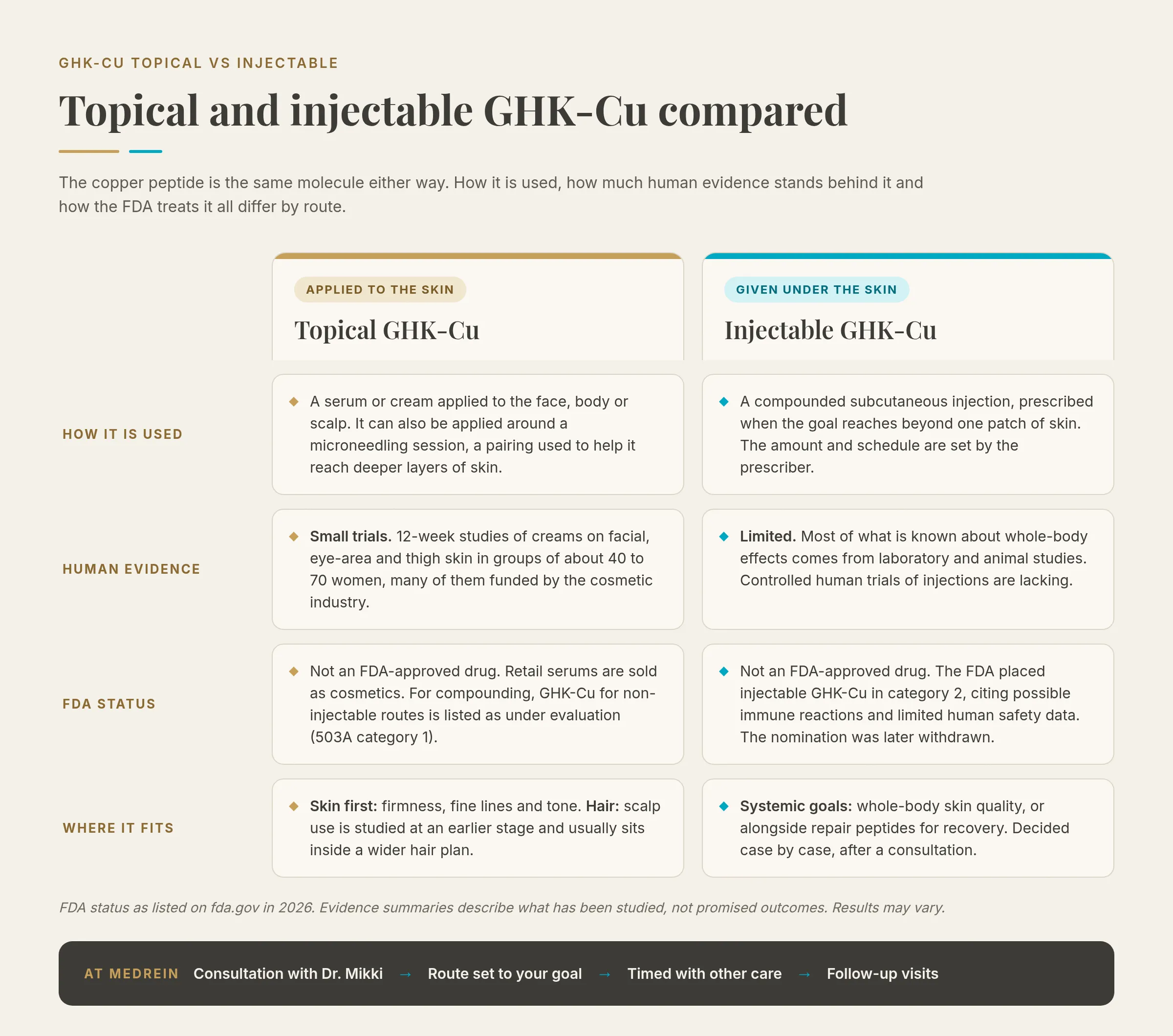
The molecule is the same either way. What changes is how deep it goes, how much human evidence stands behind it and how the FDA treats it.
Topical serums and compounded topicals
Most people meet GHK-Cu as a serum or cream. Retail products vary widely in strength and stability, and the peptide does not travel far into intact skin on its own. A compounded topical is prescribed at a known concentration and applied to the area being treated, which suits goals on the surface such as tone, texture and fine lines.
Injectable GHK-Cu
A subcutaneous injection sends the peptide into the bloodstream, so its effects are not limited to one patch of skin. This is the route with the thinnest human evidence and the clearest FDA concerns, covered in the next section. Dr. Mikki prescribes it only when the goal calls for it and after explaining that status.
GHK-Cu with Microneedling
Microneedling creates tiny channels in the skin, and applying GHK-Cu around a session is used to help it reach deeper layers. It pairs in the same way with Microneedling with PRP/PRF, Chemical Peels and Laser Skin Resurfacing, where the peptide may support healing and collagen production. If you are weighing other regenerative topicals, our guide to PDRN in skincare covers a related option.
Is GHK-Cu FDA-approved?
No. GHK-Cu is not approved by the FDA as a drug for any condition. How it is regulated depends on the product and the route.
Serums and creams that contain copper peptides are sold as cosmetics. The FDA explains that whether a product counts as a cosmetic or a drug depends on its intended use, and cosmetics do not need FDA approval before sale. A cosmetic can claim to improve how skin looks. It cannot claim to treat a condition.
Compounded GHK-Cu is made by a pharmacy to a prescription. For compounding under section 503A, GHK-Cu for non-injectable routes is listed by the FDA as a substance under evaluation, known as category 1. Injectable GHK-Cu is treated differently. The FDA placed it in category 2, its group of bulk substances that may present significant safety risks, and it now appears on the agency’s list of flagged compounding substances whose nominations were later withdrawn. The FDA’s stated concern is that compounded injectable GHK-Cu may trigger immune reactions because of aggregation and peptide-related impurities, and that limited human data exist to judge its safety.
These rules can change, so Dr. Mikki explains where each route stands at the time of your consultation, before anything is prescribed.
GHK-Cu side effects and who should avoid it
Topical GHK-Cu is generally well tolerated. The reactions people report most are redness, itching and mild irritation, which usually settle with continued use. Some describe the copper uglies, a temporary loss of skin texture or elasticity. It is usually linked to low-quality formulations and overuse.
Injectable GHK-Cu can cause redness, swelling or tenderness at the injection site, and its long-term safety in people has not been established. NPR reporting describes clinicians seeing raised liver enzymes and copper levels in people who self-injected large amounts bought from online sellers. Products labelled “for research use” carry no purity or strength standards, so you cannot know what is in the vial.
Safety data are lacking for several groups. Tell Dr. Mikki if you are pregnant or breastfeeding, have a condition that affects copper metabolism such as Wilson disease, have a history of cancer, or have sensitive or rosacea-prone skin. GHK-Cu is also a poor fit if what your face needs is volume or lift, which a different treatment answers better.
How long GHK-Cu takes to work
Skin remodeling is slow, and the timeline Dr. Mikki describes follows three bands:
- Within about 14 days: a smoother surface texture and less redness, which is a surface change.
- The second month: better resilience and a more even tone as cell turnover picks up.
- Around three months: changes in firmness and fine lines as collagen and elastin remodel.
That three-month mark lines up with the 12-week length of most published skin studies. Hair changes take longer, because a follicle cycle runs for months. Results may vary with your skin type, age and routine.
How GHK-Cu fits a skin or hair plan at Medrein
Every plan starts with a consultation. Dr. Mikki evaluates your skin, hair or nail concerns alongside your medical history and tells you plainly whether a copper peptide is the right tool. If it is, she matches the route to your goal and sets the concentration. There is no shelf dose you choose yourself.
GHK-Cu is often timed around other treatments, such as a Microneedling session, a Chemical Peel or Laser Skin Resurfacing, and around PRP/PRF when hair is the focus. Follow-up visits check how your skin is responding, and the plan is adjusted as it changes. For pigment and tone concerns, device treatments are often the better route, and our aesthetic peptides page explains where the copper peptide sits among the skin options.
Cost depends on the route, the concentration and whether GHK-Cu runs on its own or inside a combined plan. Medrein does not publish peptide prices, and you receive a quote at your consultation.
GHK-Cu is not an FDA-approved drug, and the FDA has flagged safety concerns about compounded injectable GHK-Cu. Whether a topical, an injection or neither suits you is decided at a consultation, after a history and an exam. Results may vary.
Getting started with GHK-Cu at Medrein
GHK-Cu has solid laboratory science and a modest body of human evidence, most of it for topical use on skin. It tends to suit people who want a gradual change in skin quality and are comfortable waiting around three months to judge it.
If you are thinking about a copper peptide for your skin or hair, book a consultation at our Southlake clinic. Dr. Mikki will go through your goals and history and tell you plainly whether GHK-Cu fits.
GHK-Cu Questions, Answered
Is GHK-Cu FDA-approved?
No, GHK-Cu is not an FDA-approved drug for any condition. Serums and creams that contain it are sold as cosmetics. Compounded GHK-Cu is made by a pharmacy to a prescription, and the FDA has listed safety concerns about compounded injectable GHK-Cu, including possible immune reactions and limited human safety data.
What are the side effects of GHK-Cu?
On the skin, the most common reactions are redness, itching and irritation, which usually settle. Some people describe a temporary dip in skin texture, often called the copper uglies, which is linked to low-quality products and overuse. Injections can cause reactions at the injection site, and their long-term safety in people has not been established.
Is it safe to inject GHK-Cu every day?
There are no controlled human trials that establish the safety of daily GHK-Cu injections, and the FDA has flagged safety concerns about the injectable form. Whether an injection makes sense at all, and on what schedule, is a prescriber's decision after a consultation. Self-injecting products bought online carries added risk because their purity and strength are unknown.
How long does GHK-Cu take to work?
Surface texture and redness can improve within about two weeks, tone and resilience in the second month, and changes in firmness and fine lines around three months, broadly matching the 12-week length of most published studies. Results may vary with your skin, age and routine.
Can GHK-Cu help with hair loss?
Possibly, but the evidence is early: GHK-Cu is studied for follicle support and blood flow to the scalp, though most of that research is laboratory and animal work rather than human trials. At Medrein it is usually added to a wider Hair Restoration plan, for example alongside PRP/PRF, after the cause of the thinning has been assessed. Results may vary.
How much does GHK-Cu cost at Medrein?
Cost depends on the route, the concentration and whether GHK-Cu is used on its own or as part of a combined plan. Medrein does not publish a price list for peptides, and you receive a quote at your consultation before anything is prescribed.
Is GHK-Cu right for your skin or hair?
Book a consultation and Dr. Mikki will go through your skin or hair goals, explain the topical and injectable options, and give you a quote before anything starts.
Related Articles

Peptides for Muscle Growth: Evidence, Safety & FDA Status
Peptides for muscle growth compared: growth hormone peptides vs recovery peptides, rated by evidence with FDA and WADA status in one chart. Book a consultation.

Tesamorelin for Belly Fat: Results Timeline & Side Effects
Tesamorelin explained by a Southlake MD: what the FDA label says, side effects, who qualifies, and a week-by-week results timeline chart. Book a consultation.

Peptides for Weight Loss: How They Work & Who They're For
How do peptides for weight loss actually work, and which ones are physician-supervised? A board-certified MD explains the real options and who is a candidate.